
Review · USA
Hawaiian Tikis and Guava Tea
The most unusual part of this Big Island outing is that Jason and Nikki built the art and structures themselves. You walk a rough lava path through Fern Forest, passing seven life-sized tikis, handmade stone carvings, more than 300 hapuʻu ferns, and The Okina, a tiny recycled-pallet house. I like the personal scale and the clear link between art, plants, and off-grid living. The main drawback is the uneven ground, which may be tiring if you want a gentle, polished garden visit.
I also like that you can do more than look. Jason has let children try wood carving and rock chiseling, and the small group size gives the visit a friendly, hands-on feel. At $75 per person for about two hours, the price makes the most sense if you care about local creativity, tropical plants, and practical homesteading rather than a standard sightseeing stop.
Key points to know before booking
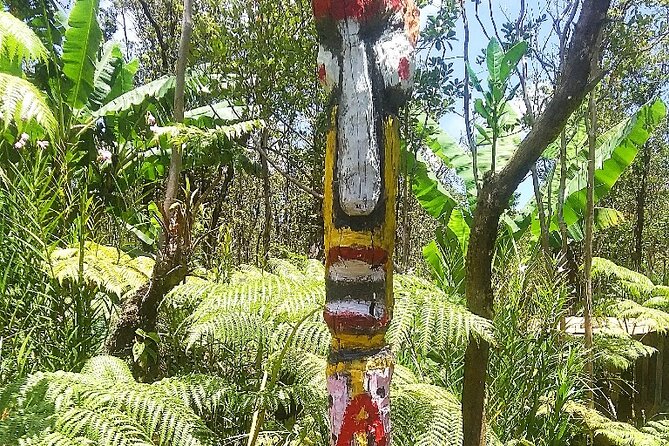
- Seven chess-themed tikis greet you at the entrance, each life-sized and hand-carved.
- More than 300 hapuʻu ferns grow along a natural lava-flow path, giving the walk a real jungle setting rather than a landscaped park feel.
- The Okina is built from recycled pallets, with solar electricity, water catchment, artwork, and about 100 square feet of interior space.
- Jason and Nikki lead the visit, sharing their work and off-grid way of life in a personal setting.
- The route is naturally uneven, so sturdy shoes and a willingness to walk over rough lava are sensible.
- The group is limited to 10 people, with a 2:30 pm start and a return to the same meeting point.
A handmade welcome in Fern Forest
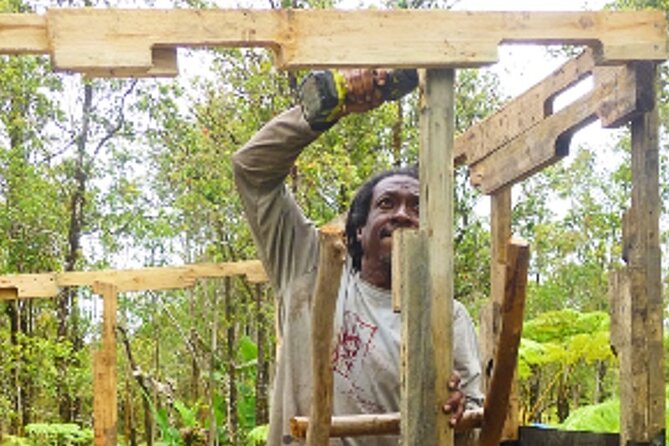
Your visit begins on Jungle King Avenue in Fern Forest at 2:30 pm. This is not a large attraction with signs, ticket booths, and a fixed parade of stops. It is a small property shaped by the work of two people, Jason and Nikki, who cleared the land and built the structures and art themselves.
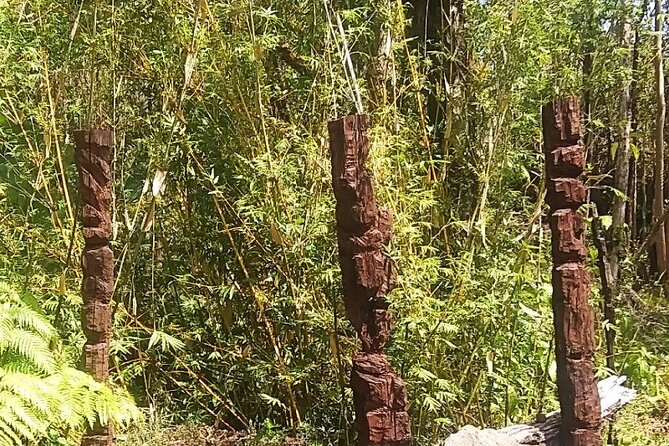
The first sight is a row of seven life-sized Hawaiian tikis along a fence made from recycled wooden pallets. The figures represent the pieces of a chess game, giving the entrance a playful idea as well as a strong visual welcome. I would allow a few minutes here to look closely at the carving and the fence construction before moving on.
The recycled materials matter because they connect the art to the way the property operates. You are not simply viewing decorative statues. You are seeing a working example of how pallets, lava rock, salvaged materials, solar power, and water collection can become part of a home and creative space.
Jason and Nikki’s role is central to the experience. The visit has more character because the people who made the place can explain it directly. Their enthusiasm for off-grid living and handmade construction is one of the strongest reasons to choose this activity over a more conventional garden or walking tour.
A few more tea experiences around the USA worth a look
- Tea Around Town: High Tea Experience and Tour of Washington DC
★ 4.0 · 154 reviews - SF’s Chinatown: Tea & Dim Sum Food Tour – Includes full meal, 3hr
★ 5.0 · 153 reviews - Tea Around Town® NYC: Mobile Tea Room Experience
★ 3.5 · 99 reviews
Following the uneven lava path
The main walk follows a naturally formed path over uneven lava. That detail should shape your expectations. This is a forest property, not a smooth paved trail, so you will want shoes that feel secure on irregular ground. The supplied information says most people can participate, but the route still deserves a little care.
As you walk, you pass more than 300 hapuʻu ferns growing in their natural setting. Hapuʻu are tree ferns associated with the wet highland areas of Hawaii, and seeing a large collection growing outdoors gives the plant stop real value. You are not just looking at isolated specimens with labels. The ferns form part of the forest around you, alongside tropical plants, trees, and wildlife.
I like this section because it gives the tour a useful rhythm. The tikis and stone carvings are bold and made by hand. The ferns are quieter, slower, and entirely shaped by the forest. Together, they show two kinds of creativity: the work of the maker and the work of nature.
Do not expect a formal botanical lesson with a long list of plant names. The available details promise information about the plants in the area, but they do not give a full species-by-species program. If you are keen on tropical botany, this is best viewed as a personal introduction to the plants around the property rather than a specialist garden course.
The forest setting also means that the visit may feel different from one day to the next. Light, moisture, and the sounds of wildlife are part of the atmosphere, but the tour is not designed as a wildlife-watching excursion. I would come for the plants and the setting, with any animal sightings treated as a bonus.
Lava rock sculptures and the Rasta stone figure
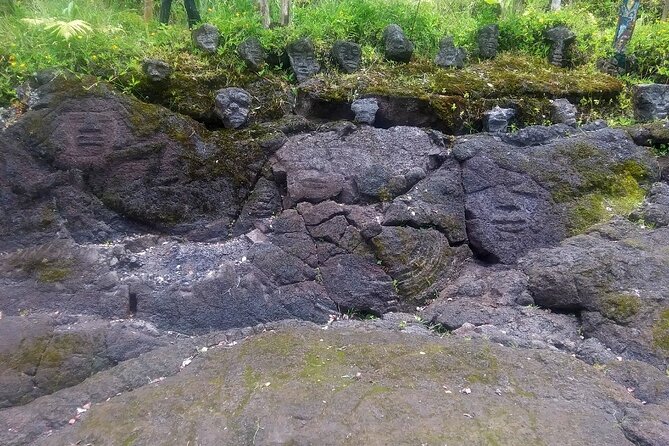
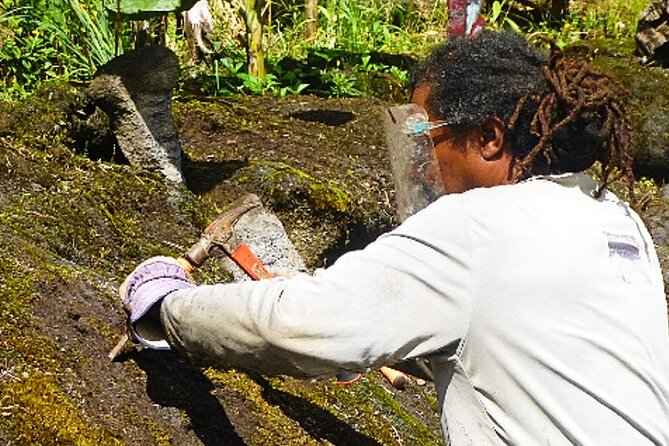
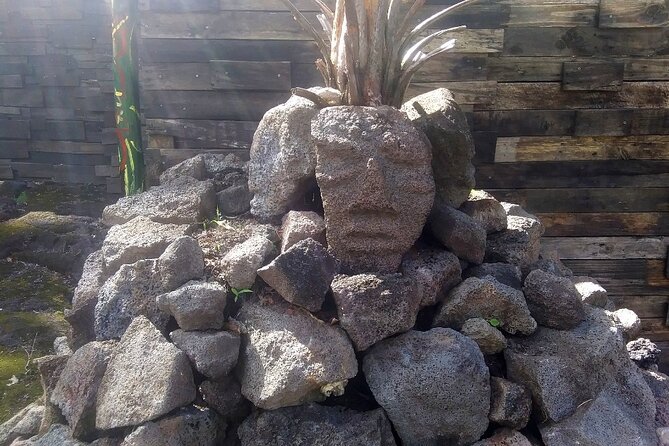
Along the route, you see lava rock sculptures, including a Rasta stone sculpture that remains in its original position. The use of lava rock makes sense on the Big Island, where volcanic stone is part of the physical setting and daily life. Here, the rock is not hidden or hauled away. It becomes the raw material for art.
This section helps explain Jason’s style. His work uses the materials close at hand, and the sculptures sit within the forest rather than in a formal gallery. That makes the experience more personal, but it also means the presentation is informal. You may need to listen carefully and look around rather than follow a heavily marked route.
One especially nice feature is the chance for a child to try carving wood and chiseling rock, when offered by Jason. This is a memorable detail for families because it turns the visit into an activity rather than a walk where children are expected to keep their hands to themselves. The information provided does not promise that every child will get hands-on time, so I would treat it as a possibility, not a guaranteed part of the ticket.
For adults, the stonework offers a good reason to slow down. I would ask about how the rock was shaped, how the property was cleared, and which structures use recycled materials. Since Jason and Nikki created the site themselves, questions about the process are likely to add more than rushing from one object to the next.
Inside The Okina, a tiny recycled-pallet house
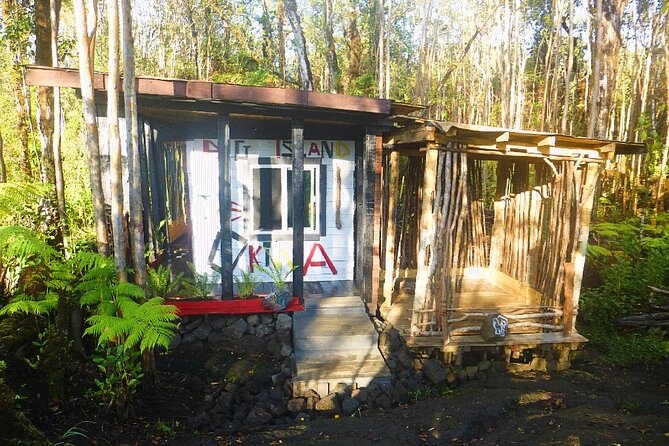
The route leads to The Okina, a prototype house and art installation built entirely from recycled pallets. Its hallways and sleeping area cover about 100 square feet, so the space is intentionally compact. This is less a full-size home tour and more a close look at a creative shelter design.
The Okina includes several original mixed-media artworks, solar electricity, and a water-catchment system. Those features make the structure useful as a demonstration of off-grid ideas. You can see how a very small building might combine shelter, art, energy collection, and water storage in one compact project.
The small size is part of the point, but it can also be a limitation. If you are expecting a roomy cabin or a long indoor visit, you may find The Okina more interesting as a design concept than as a comfortable building. Its value comes from the ideas it presents and the labor behind it, not from space or luxury.
You can also book The Okina separately through Airbnb, according to the information provided. That is not included in the two-hour tour, but it gives you the option of spending a night in the forest and hearing its sounds after dark. I would consider that only if you specifically want an off-grid stay and understand that the structure is very small.
The overnight option also helps explain why the tour can appeal to people curious about a different way of living. You get to see the ideas in daylight first, then decide if a longer stay fits your trip. For most visitors, the tour alone is enough to understand the property. For a few, the cabin adds a second, more personal experience.
Same place, a different pot:
- Charleston: Wadmalaw Island Wine Tasting and Tea Garden Trip
★ 4.9 · 94 reviews - Tea Around Town: A Delightful Atlanta Experience
★ 3.5 · 91 reviews - Wine Sippin’-Tea Drinkin’-Tree Huggin’ Lowcountry Sightseeing
★ 5.0 · 88 reviews - Tea Around Town Dallas: Sip and Savor the Sights
★ 3.0 · 81 reviews
What the $75 price really covers
At $75 per person, this is not the cheapest way to spend two hours on the Big Island. You are not paying for a major attraction, a long drive, or a large collection of exhibits. The value comes from access to a private creative property, direct time with its makers, a small group, and a setting that combines sculpture, plants, and practical off-grid construction.
The maximum group size is 10 people. That matters here because the property is personal and the structures are small. A group of 30 would change the mood and make it harder to hear Jason and Nikki or examine the art. With fewer people, you have a better chance to ask questions and keep the visit conversational.
I think the price works best for three types of visitors. First are people who enjoy handmade art and want to meet the people behind it. Second are families looking for a Big Island activity where a child may get to try simple carving. Third are visitors interested in solar power, water catchment, recycled building materials, and life away from the usual utility grid.
The value is weaker if you mainly want dramatic volcanic scenery, a polished botanical garden, or a long guided nature walk. This outing is about one property and the ideas expressed through it. It does not replace a national park visit or a broad island tour.
The experience is offered in English and includes a mobile ticket. Service animals are allowed, and the property is near public transportation. The information says most people can participate, but it does not describe the path as accessible or paved. Because the trail is uneven lava, I would contact the provider before booking if you need a smooth route or have trouble walking over rough ground.
Timing, group size, and the practical side
The tour lasts about two hours and begins at 2:30 pm. It ends back at the same meeting point on Jungle King Avenue. That afternoon timing can fit well after a morning activity, but you should allow enough time to reach Fern Forest without cutting it close.
The meeting point is listed in Fern Forest, Hawaii, with the ZIP code 96778. The provided details do not include a hotel pickup service, so you should plan to reach the starting point on your own unless the provider tells you otherwise.
Because the property contains narrow spaces, hand-built structures, and an uneven lava path, a small group is especially useful. You will likely spend time standing, walking, and pausing at several points. I would wear sturdy closed shoes and bring the practical outdoor basics you normally use for a forest visit, though the supplied details do not list a formal packing list.
The booking pattern also gives you a planning clue: the experience is booked about 33 days ahead on average. That does not mean every date sells out, but it suggests you should not assume you can leave it until the last afternoon of your trip. If the tour fits your plans, booking early is sensible.
You receive confirmation when you book. Free cancellation is available if you cancel at least 24 hours before the 2:30 pm start time. Inside that window, the payment is not refunded and changes are not accepted. The cut-off uses local time, so keep that in mind if you are arranging several Big Island activities.
Who will enjoy this most
I would recommend this outing to anyone who prefers a personal, handmade experience to a large commercial attraction. It is especially well suited to families with curious children, couples interested in creative building, and visitors who want to understand practical off-grid living.
The family appeal is strong because the property offers several kinds of interest in a short visit. A child can look at the chess tikis, search for wildlife and tropical plants, see the small cabin, and possibly try carving with Jason. An adult can focus on recycled construction, solar electricity, water collection, and the work needed to clear and shape the property.
Art lovers should come with time to look closely. The tikis and lava carvings are not mass-produced souvenirs. They are part of one person’s continuing work, and the property itself is the frame in which that work is shown.
I would be more cautious about recommending it to someone seeking a smooth, accessible garden route or a high-energy adventure. The path is uneven, the cabin is tiny, and the experience depends on your interest in the hosts’ projects. There is no evidence that the tour includes a broad island history lesson, a long hike, or a formal tea service.
The name includes Guava Tea, but the supplied details do not explain when tea is served, what it includes, or whether it is part of every visit. If that detail is important to you, ask Paradise Unplugged before booking rather than assuming the name guarantees a specific tasting.
My call: book it for the story behind the place
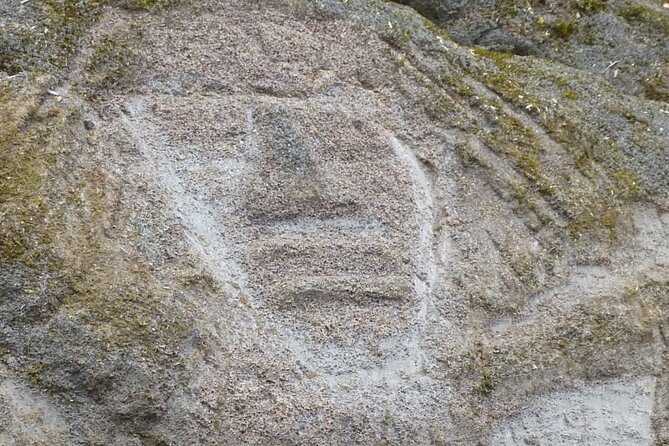
Book Hawaiian Tikis and Guava Tea if you want a small, direct encounter with Jason and Nikki’s work in Fern Forest. The best parts are the seven chess-themed tikis, the large hapuʻu fern collection, the lava sculptures, and The Okina’s smart use of recycled pallets, solar electricity, and collected water.
Skip it if you want a major volcanic viewpoint, a polished garden, or an easy paved walk. At $75, the experience earns its price through access to a personal property and the chance to ask questions, not through size or spectacle. For families and curious makers, it could be one of the more memorable two-hour stops on the Big Island.
FAQ
Where does Hawaiian Tikis and Guava Tea begin?
The tour begins on Jungle King Avenue in Fern Forest, Hawaii, ZIP code 96778.
What time does the tour start?
The start time is 2:30 pm.
How long does the experience last?
The experience lasts approximately two hours.
Where does the tour end?
The activity ends back at the meeting point on Jungle King Avenue.
How many people can join the tour?
The tour has a maximum group size of 10 people.
Is the tour offered in English?
Yes. The experience is offered in English.
Can I cancel for a full refund?
Yes. You can cancel at least 24 hours before the local start time for a full refund. Cancellations or changes made less than 24 hours before the start are not accepted and are not refunded.
Just added around the USA
- Washington, D.C.: Tea Around Town Bus Tour with Landmarks★ 3.4 · 7 reviews
- Tea By The Sea★ 5.0 · 9 reviews
- Tea Blending★ 4.5 · 8 reviews
- Tea Around Town: A Charming Tea Experience in Philadelphia★ 3.5 · 24 reviews
- Premium Loose Leaf Tea and Chocolate Tasting★ 3.0 · 4 reviews
- St. Johns River High-Tea Cruise Tour in Sanford★ 5.0 · 2 reviews
- Seftel Gallery Art Experience – Meet the Artist near Santa Fe★ 5.0 · 6 reviews
- Beach Yoga & Tea Experience on South Beach★ 5.0 · 19 reviews
USA Tea Experiences, compared.

Tea Around Town: High Tea Experience and Tour of Washington DC
Read our review →
SF’s Chinatown: Tea & Dim Sum Food Tour – Includes full meal, 3hr
Read our review →
Tea Around Town® NYC: Mobile Tea Room Experience
Read our review →
Wadmalaw Island Wine Tasting and Tea Garden Trip
Read our review →
Tea Around Town: A Delightful Atlanta Experience
Read our review →
Wine Sippin’-Tea Drinkin’-Tree Huggin’ Lowcountry Sightseeing
Read our review →
Tea Around Town Dallas: Sip and Savor the Sights
Read our review →
NYC: Tea Around Town Bus Tour with Live Entertainment
Read our review →Browse the lists this tour appears in