
Review · BEIJING
Beijing Culture: Tea Ceremony, Heritage Instrument & Calligraphy
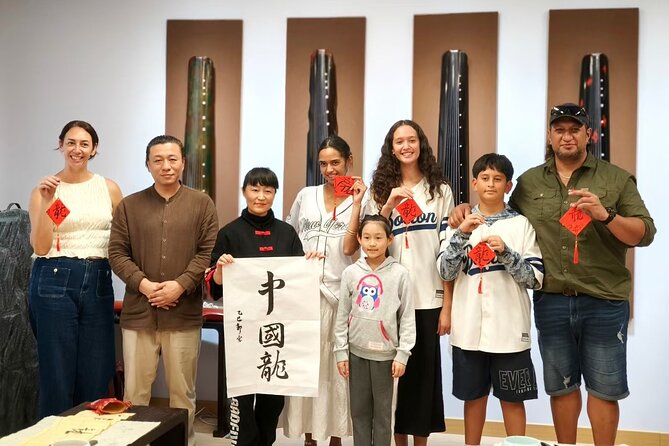
The most unusual part of this Beijing experience is that you do not just watch Chinese traditions from a polite distance. You brew tea, guide a brush across paper, and place your fingers on the strings of the Guqin, one of China’s oldest classical instruments. The setting is private, quiet, and limited to eight people.
I like the direct contact with living culture, especially the chance to play a complete melody rather than simply hear a performance. I also like the thoughtful mix of tea, music, and calligraphy, with a bilingual guide explaining the ideas behind each ritual. The main drawback is the price: at $78.60 per person, it is not a quick, casual stop, and transportation to the venue is not included.
Key details at a glance
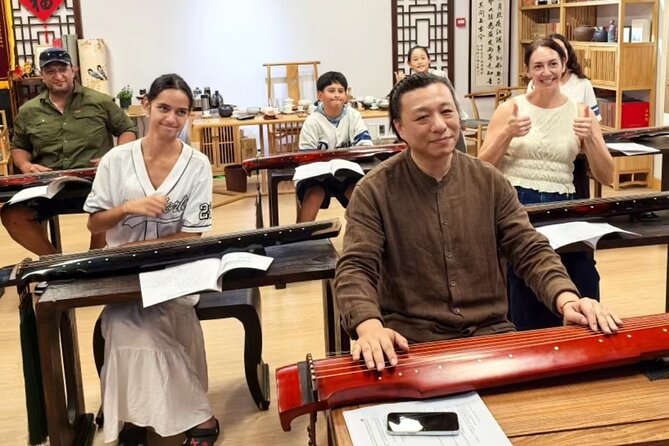
- Play the Guqin yourself: A national-level heritage artist performs first, then guides you through a full melody.
- Learn Chinese calligraphy: You write real Chinese characters and can take your work home.
- Taste tea with a certified master: The tea session includes brewing, tasting, ceremony, and light snacks.
- Small group setting: A maximum of eight people allows for individual help with brush strokes and finger placement.
- Quiet private venue: The workshop takes place at an air-conditioned heritage space in Beijing’s 813 Creative Park.
- Traditional dress included: Rental attire is available for ritual participation and photographs.
Why this workshop feels different from a staged cultural show
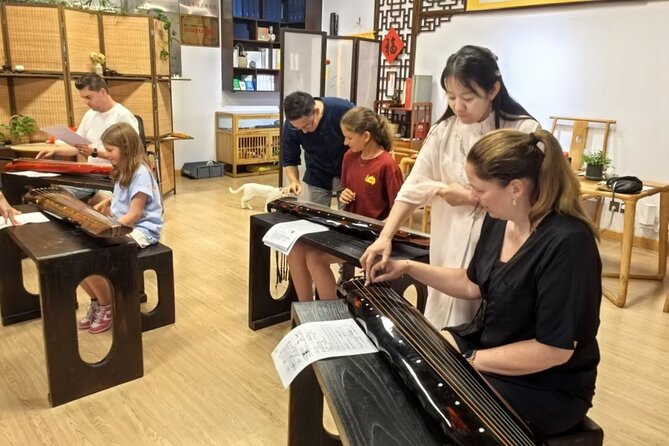
Many Beijing cultural activities ask you to sit, watch, applaud, and leave with a few photographs. This one gives you a task at every stage. Your hands are busy, but the explanations keep the activity from becoming a string of disconnected demonstrations.
The setting is a private heritage venue rather than a large public attraction. That matters. You get a calmer room, fewer distractions, and more time to ask questions. The group limit of eight is another practical advantage. A teacher can correct your brush grip or move your fingers on the Guqin without trying to manage a crowd.
The English guidance comes from a bilingual host with an M.A. in History and Sociology, trained in Chinese philosophy and history. No specific guide name is provided, but the role is more substantial than simple translation. You are meant to understand why the gestures matter, not just copy them.
The experience lasts about two and a half hours. That is long enough to give each tradition room, but short enough to fit into a busy Beijing schedule. I would treat it as a focused cultural workshop, not a full-day sightseeing tour.
More Tea and Calligraphy Classes in Beijing:
- Beijing Culture Event: Tradition Music, Tea Ceremony, Calligraphy
★ 5.0 · 11 reviews - Beijing Hands-On Culture Tour: Tea, Instrument, Calligraphy
★ 5.0 · 6 reviews - Beijing:Learn Calligraphy & Enjoy Kung Fu Tea Ceremony
★ 5.0 · 2 reviews
Tea first: a calm introduction to Chinese ritual
The tea ceremony opens the session and sets the pace. You receive tea snacks, learn about the tea being served, and take part in brewing and tasting under the direction of a certified tea master.
The value here is not simply drinking a better cup of tea. The process draws attention to water, timing, pouring, aroma, and presentation. The master explains the ritual, so you can see how a familiar drink becomes a form of hospitality and concentration.
You should expect a measured, unhurried start. That is part of the appeal. The ceremony offers a quiet break from Beijing’s traffic, crowds, and packed sightseeing routes. Warm tea and live music later in the session create a restful mood, but the experience remains active because you are expected to participate.
Tea lovers will get the most from this section, though no previous knowledge is required. The workshop is designed to make the ceremony approachable for someone who knows little about Chinese customs. If you want a fast tasting with several varieties and no explanation, this may feel too slow. If you enjoy learning through small actions, it is a strong opening.
The tea service includes snacks, but it is not a meal. Plan to eat separately if you need lunch or dinner.
The Guqin: from a live performance to your first melody
The Guqin session is likely to be the emotional center of the afternoon. A national-level heritage artist first performs on the instrument, giving you a chance to hear its quiet, restrained sound before you try it yourself.
The Guqin is not presented as a modern stage instrument. Its importance comes from its long place in Chinese scholarly and artistic life. The music can sound spare and delicate, so the room’s peaceful atmosphere helps. This is not the sort of performance that works best with a noisy audience or constant movement.
After the performance, you receive hands-on instruction. The artist guides your fingers and helps you play a full melody. That promise is important. You are not merely plucking one string for a photograph, then stepping aside. You get a small but complete musical achievement.
Do not expect to become a Guqin player in one lesson. The instrument has a refined technique, and your first attempt may be hesitant. That is precisely why the individual help matters. A small group gives the artist more room to adjust your hand position and keep the lesson moving.
This section suits curious beginners, music lovers, and anyone who values trying a difficult thing for a short time. It also suits people who prefer quiet cultural experiences to loud evening shows. The limitation is obvious: if you want a longer concert or serious technical training, two and a half hours shared among three traditions will not provide it.
Still, playing a melody yourself changes the experience. You leave with a physical memory of the instrument, not just a photograph of someone else performing.
Calligraphy that gives you something to take home
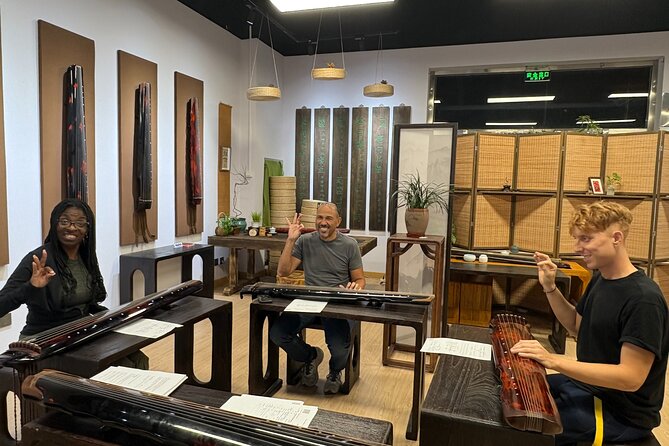
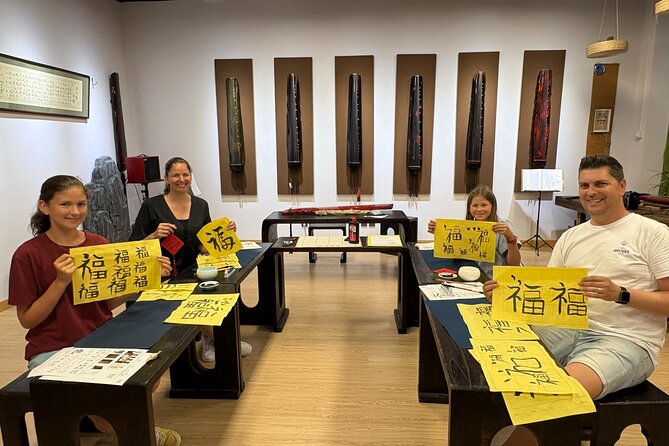
The calligraphy workshop offers the most useful souvenir. Under expert guidance, you write traditional Chinese characters with a brush and learn about their ancient roots.
You may write your Chinese name, which makes the session personal without requiring you to know Chinese beforehand. The teacher helps with the form of the characters and the feel of the brush. A finished piece of paper can be taken home and framed, giving you a keepsake with more meaning than a shop-bought decoration.
Calligraphy is harder than it appears. Brush pressure, balance, spacing, and stroke order all affect the result. Do not judge your work against the teacher’s. The point is to feel how the writing is made and understand that the characters are not just abstract marks.
This part is especially good for families, couples, and first-time visitors who want a clear activity with a visible result. It also adds variety after the quiet tea and music sessions. You move from sipping and listening to making something with your own hands.
The teacher’s help is a major part of the value. A brush and ink lesson without guidance can quickly become messy and confusing. Here, the instruction links the physical strokes with the older meaning of the characters.
More Tea Ceremony Experiences in Beijing:
- Traditional Chinese Tea Ceremony Experience
★ 4.7 · 74 reviews - Chinese Tea ceremony in Beijing Hutong courtyard
★ 4.7 · 26 reviews - Beijing: Temple Of Heaven+Tai Chi Class+Tea Ceremony
★ 5.0 · 8 reviews - Traditional Chinese Tea Ceremony Experience
★ 5.0 · 7 reviews
Traditional clothing and the private venue
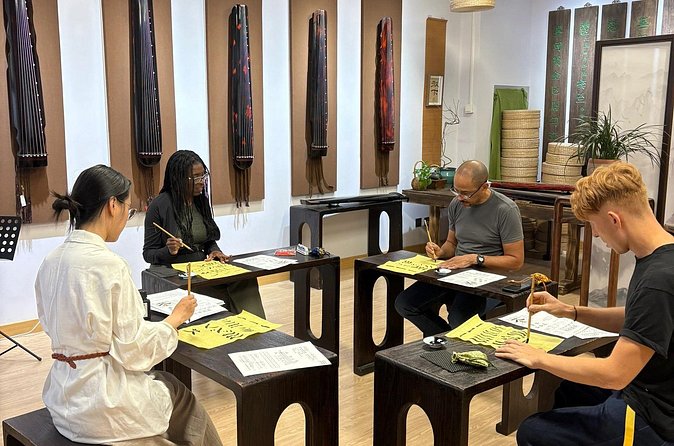
Traditional attire rental is included for the ritual and photographs. This is a small detail, but it helps the session feel distinct from an ordinary craft class. You can take photographs in clothing suited to the setting rather than posing in everyday sightseeing clothes.
The venue is air-conditioned, which is useful in Beijing’s hotter months and welcome after time outdoors. It is located at 813 Creative Park in Chaoyang, at VGP3+CCX, Beijing, 100124. The meeting point is also the end point, so there is no mid-session transfer to organize.
The workshop is near public transportation, but the price does not include travel to or from the venue. You will need to plan that part yourself. Give yourself enough time to reach the meeting point, particularly if you are coming from another part of Beijing.
The space is described as closed to the public and designed to protect these traditions. That can make the session feel more personal than a standard attraction, though the location may be less convenient than a central hotel or major sightseeing site. Check your route before booking and allow for Beijing traffic.
What the $78.60 price buys you
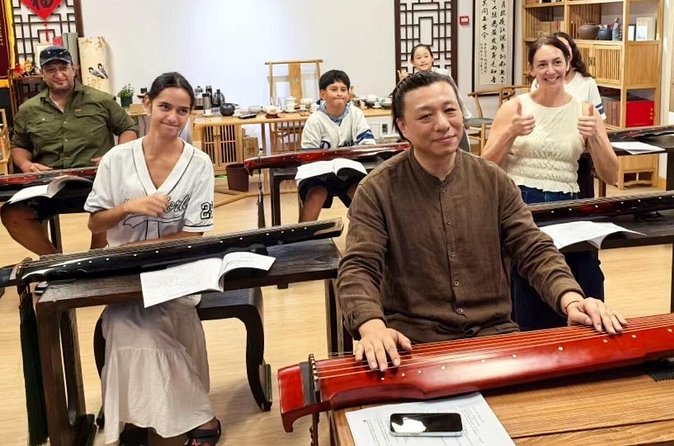
At $78.60 per person, this is a premium two-and-a-half-hour activity. The value depends on what you want from your Beijing visit.
The fee covers the tea ceremony and tasting, tea snacks, a live Guqin performance, a hands-on Guqin lesson, calligraphy instruction, traditional attire rental, and bilingual guidance. You are paying for several teachers and a small group rather than for admission to a single show.
The group limit is especially important when considering the price. With no more than eight participants, the lesson can include personal correction and questions. That is more useful for calligraphy and music than a large demonstration would be.
The price is harder to justify if you want a cheap introduction, a quick photo opportunity, or a broad city tour. Transportation and meals beyond the provided tea snacks are extra. You should also understand that the workshop is not a replacement for visiting Beijing’s major historic sites.
For someone who values participation, the cost is reasonable. You receive three hands-on cultural activities and a finished calligraphy piece, while the Guqin lesson creates a memory that a regular museum visit cannot provide. For a tight budget, compare it with free cultural displays or public performances before committing.
Who should book this Beijing experience
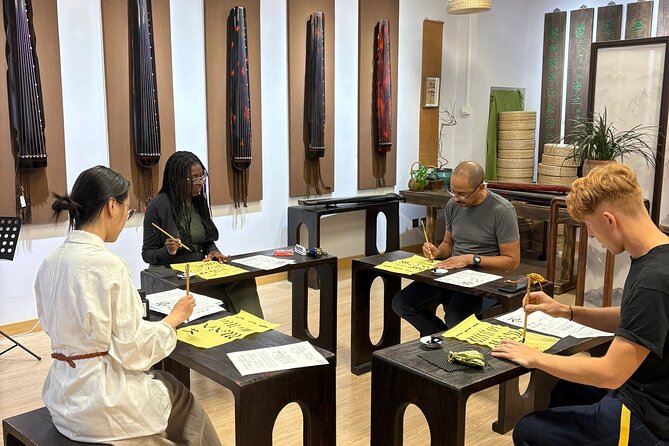
I would recommend it to you if you want a quiet cultural activity with clear instruction and a small group. It is particularly well suited to:
- First-time visitors who want context, not just photographs
- Couples looking for a calm shared activity
- Families with older children who can follow hands-on instruction
- Music lovers curious about an ancient Chinese instrument
- Anyone who wants to try calligraphy without arranging a private lesson
- Repeat visitors who have already seen the main monuments and want a slower afternoon
You do not need prior experience with tea, Chinese writing, or music. The teaching is designed for beginners, and the bilingual guide explains the meaning behind the actions.
I would hesitate to recommend it if you mainly want a large-scale performance, a full meal, or a central Beijing sightseeing route. It also may not suit someone who dislikes slow ceremonies or careful practice. The activity asks you to pay attention and take part.
Service animals are allowed, and most people can participate. The available information does not give detailed accessibility specifications, so contact the provider directly if you need particular seating, mobility, or communication arrangements.
Timing, booking, and cancellation details
The experience is usually booked about 51 days ahead, which suggests that you should reserve early if your Beijing dates are fixed. Confirmation is sent within 48 hours of booking, subject to availability.
You can cancel for a full refund up to 24 hours before the local start time. Changes or cancellations inside that 24-hour window are not accepted for a refund.
The activity requires a minimum number of participants. If that minimum is not met, you are offered another date or experience, or a full refund. Poor weather can also lead to a cancellation, with the same choice of another date or a refund. That condition is worth noting even though the workshop is indoors.
The mobile ticket is convenient. Keep it accessible when you arrive at the 813 Creative Park meeting point.
My call: book it for participation, not spectacle
You should book this experience if you want to touch Chinese culture in a literal way. The tea ceremony slows you down, the Guqin lesson gives you a rare musical encounter, and calligraphy sends you home with something you made yourself.
The strongest feature is the combination of expert teaching and a small group. The most memorable moments are likely to come from small actions: brewing your tea, feeling a Guqin string respond, or seeing a character take shape under your brush.
Skip it if your priority is low cost, a major landmark, or a long concert. At $78.60, it asks you to value instruction and personal attention. For the right visitor, that is a fair trade for a peaceful, thoughtful afternoon in Beijing.
FAQ
How long does the Beijing culture experience last?
The activity lasts approximately 2 hours and 30 minutes.
Where does the experience begin and end?
It begins and ends at 813 Creative Park, VGP3+CCX, Chaoyang, Beijing, China, 100124.
What activities are included?
The experience includes a traditional tea ceremony and tasting, tea snacks, a live Guqin performance, a hands-on Guqin lesson, Chinese calligraphy instruction, traditional clothing rental, and a bilingual guide.
Is transportation included?
No. Transportation to and from the venue is not included. The venue is near public transportation.
How many people can join the activity?
The group has a maximum of eight participants.
Do I need previous experience with tea, calligraphy, or the Guqin?
No previous experience is stated as a requirement. The activity provides expert guidance in all three areas and is intended to explain the customs in English.
Can I cancel for a refund?
Yes. You can cancel at least 24 hours before the local start time for a full refund. Cancellations or changes made less than 24 hours before the start time are not refunded.
More Heritage Tours in Beijing
- World Heritage Kyoto & Nara Uji Authentic Matcha Experience
★ 5.0 · 1,573 reviews - Uji: UNESCO Heritage & Tea Ceremony Walking Tour
★ 4.6 · 54 reviews - Old Delhi’s heritage, Spice market, Masala Chai & food sampling
★ 5.0 · 30 reviews - Slow Cycling Tour at Uji’s Matcha Green Tea Fields and Heritage
★ 5.0 · 25 reviews
Just added around Beijing
- Traditional Chinese Tea Ceremony Experience★ 5.0 · 7 reviews
- Beijing: Mutianyu Great Wall and Tea House Private Tour★ 5.0 · 11 reviews
- Private Beijing Spiritual Tour with Lunch and Tea Ceremony★ 5.0 · 2 reviews
- Private Tour: Tiananmen Area Night Walk with Lao She Teahouse Show★ 5.0 · 3 reviews
- Beijing Culture Event: Tradition Music, Tea Ceremony, Calligraphy★ 5.0 · 11 reviews
- Temple of Heaven Private Tour and Tea Tasting at Maliandao Tea Street★ 5.0 · 2 reviews
- Private Tour to the Temple of Heaven and Tea tasting at the Maliandao Tea city★ 5.0 · 3 reviews
- 3-hour Morning/Afternoon Tea Tasting on Maliandao Street & Dimsum★ 5.0 · 7 reviews
Tea & Calligraphy Classes, compared.
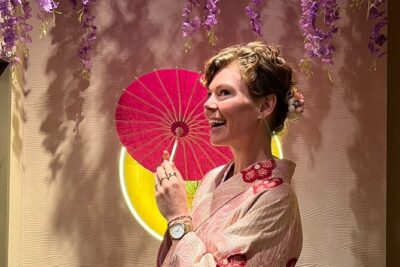
Tea Ceremony, Calligraphy, and Kimono Experience
Read our review →
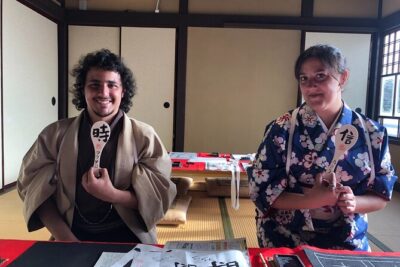
An Amazing set of Cultural experience: Kimono, Tea Ceremony and Calligraphy
Read our review →
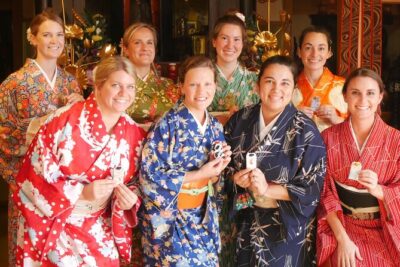
Cultural Activities :Kimono, tea ceremony, Calligraphy and Amulet
Read our review →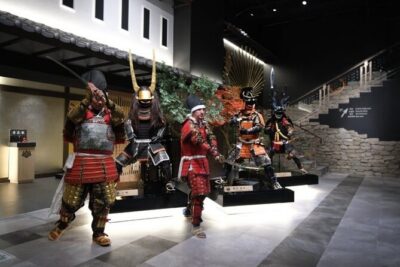
Samurai dress-up and shows, plus Tea Ceremony & Calligraphy
Read our review →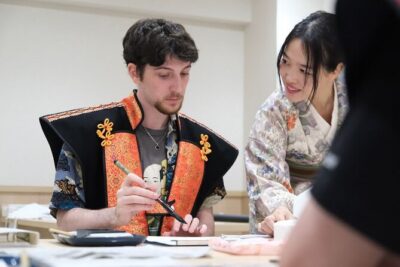
Premium Kimono Dressing, Tea Ceremony, Calligraphy, Samurai show
Read our review →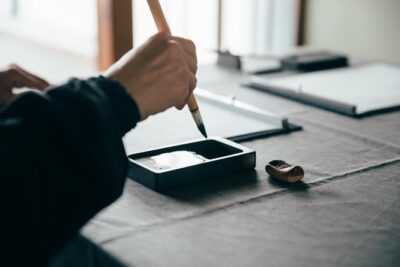
Experience Japanese calligraphy & tea ceremony at a traditional house in Nagoya
Read our review →Browse the lists this tour appears in