
Review · JAPAN
Experience Japanese calligraphy & tea ceremony at a traditional house in Nagoya
Nagoya’s best cultural moments can be easy to miss. This experience takes you inside a real kominka, or traditional farmhouse, where tatami mats, shoji screens, and a garden replace the usual sightseeing venue. You learn about the city’s samurai-era past, practice calligraphy, and take part in a tea ceremony in English.
I like the small maximum group of six, which gives the hosts room to explain the tools and correct your brush technique. I also like the finished calligraphy piece, framed as a keepsake rather than left as a loose sheet in your luggage.
The main drawback is the price: $179.63 per person for about two and a half hours is a serious spend. The experience makes the most sense if you value close contact with a local host and a traditional setting more than a long list of sights.
Key points to know before booking
- A real kominka house: You meet at a traditional home with tatami, shoji, and a Japanese garden, not in a modern activity studio.
- Sengoku history first: A roughly 15-minute slide presentation explains Nagoya’s connection to Oda Nobunaga, Toyotomi Hideyoshi, and Tokugawa Ieyasu.
- Calligraphy you make yourself: You grind an ink stick, learn brush basics, choose meaningful symbols, and receive a framed clean copy of your work.
- Tea ceremony with hands-on practice: You first receive matcha as a guest, then try serving it yourself.
- Very small group: The activity accepts no more than six people, helping keep the lesson personal.
- Plan carefully: The activity begins and ends at 4-chōme-32 Yamawakichō in Showa Ward, and the booking is non-refundable.
Entering a traditional house in Nagoya
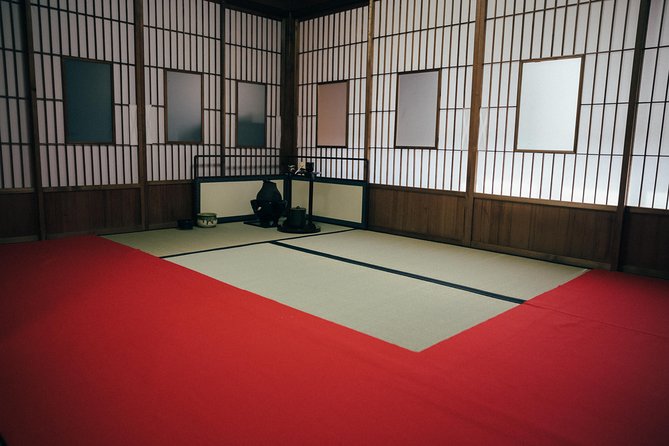
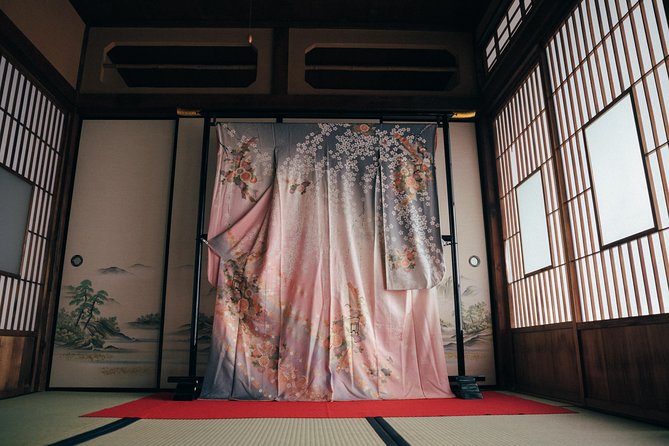
The setting does much of the teaching here. You arrive at a traditional Japanese farmhouse in Nagoya, a home where people actually lived, rather than a building arranged only for sightseeing. Inside, the quiet rooms, tatami flooring, paper shoji walls, and garden give you a clear sense of how older Japanese domestic spaces worked.
That matters because calligraphy and tea ceremony can feel abstract in a hotel room or a busy workshop. In this house, the low furniture, spare rooms, and careful arrangement of objects help explain why these activities place so much value on calm, attention, and good manners.
The meeting point is at 4-chōme-32 Yamawakichō, Showa Ward, Nagoya. It is near public transportation, though you should allow time to find the address. One useful piece of practical advice comes from the experience itself: the location is reasonably easy to find, but not necessarily the sort of place you should approach in a hurry. Keep the address and mobile ticket ready on your phone.
The tour returns to this same point at the end. That makes it easier to plan a meal or another activity afterward, but remember that the two and a half hours are approximate.
More Tea and Calligraphy Classes in Japan:
- Osaka: Tea Ceremony, Calligraphy, and Kimono Experience
★ 4.9 · 130 reviews - Experience all of Japanese culture and Japanese food experience classes “origami, udon, Japanese food, green tea, calligraphy” in 4 hours
★ 5.0 · 105 reviews - An Amazing set of Cultural experience: Kimono, Tea Ceremony and Calligraphy
★ 5.0 · 69 reviews
A short lesson on Nagoya’s Sengoku connections
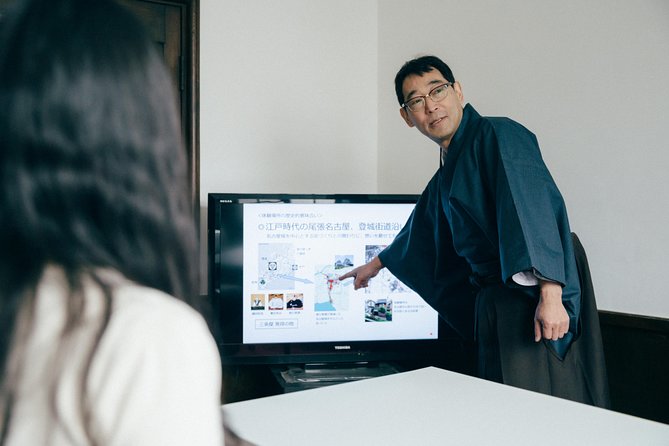
Before you pick up a brush, you receive about 15 minutes of history with an easy-to-follow slide show. The focus is the Sengoku period, the era of conflict and powerful regional lords in 16th-century Japan.
Nagoya sits in the Owari district, an area linked with three of Japan’s most famous samurai leaders: Oda Nobunaga, Toyotomi Hideyoshi, and Tokugawa Ieyasu. The point is not to turn you into a specialist in Japanese history. Instead, the presentation gives you enough context to understand why Nagoya is such a fitting place for this cultural lesson.
I appreciate this short introduction because it adds meaning without taking over the activity. Fifteen minutes is long enough to explain the setting, but short enough to leave most of your time for calligraphy and tea.
If you already know the broad outline of the Sengoku period, you may find the presentation familiar. Still, seeing Nagoya’s place in that story before entering the tea room connects the city’s past with the customs you are about to practice.
Grinding ink and making a framed calligraphy piece
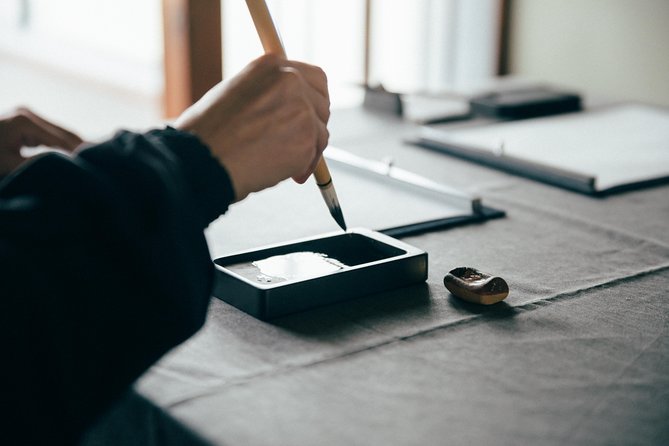
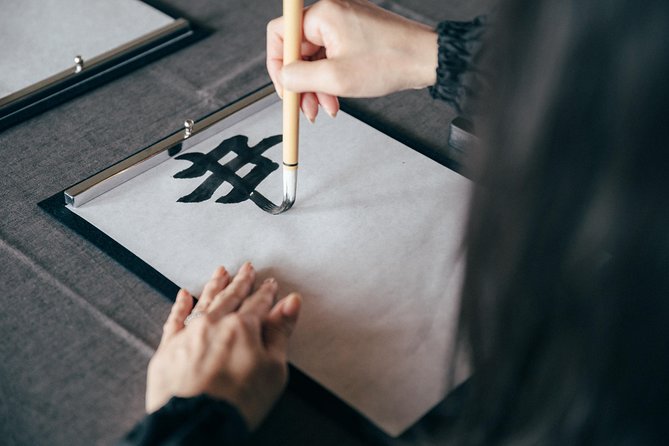
The calligraphy session begins with a task that sounds simple but changes the pace of the afternoon. You drip water onto an inkstone and slowly rub an ink stick across it. The process produces the ink you will use, along with its distinctive smell.
This is not just preparation. It forces you to slow down before writing. You are not grabbing a marker and copying a character in a few seconds. You are making the material, watching the ink develop, and getting used to the quiet atmosphere of the room.
The hosts explain the basics of holding and moving the brush. You learn how pressure, direction, and pace affect each stroke. The information provided does not promise an advanced lesson in Japanese calligraphy, and you should not expect professional-level technique after one session. The value is in learning the proper starting points and seeing how much control the brush requires.
You then select symbols from sample designs. Their meanings matter, so you can choose something that fits your interests rather than copying a random character. The activity lets you write on practice material first, giving you a chance to become familiar with the brush before producing the clean version.
Your finished clean copy is framed as a souvenir. That is a useful touch. A loose sheet can be hard to protect in a suitcase, while a framed work gives the activity a clear physical ending. You are not simply watching a demonstration. You leave with something connected to the time you spent learning the process.
All Japanese calligraphy tools are included. The supplied information also lists the framed piece as part of the calligraphy experience, while souvenirs in general are not included, so it is wise to regard the framed work as the included keepsake and not expect extra merchandise.
Matcha, sweets, and the etiquette of the tea room
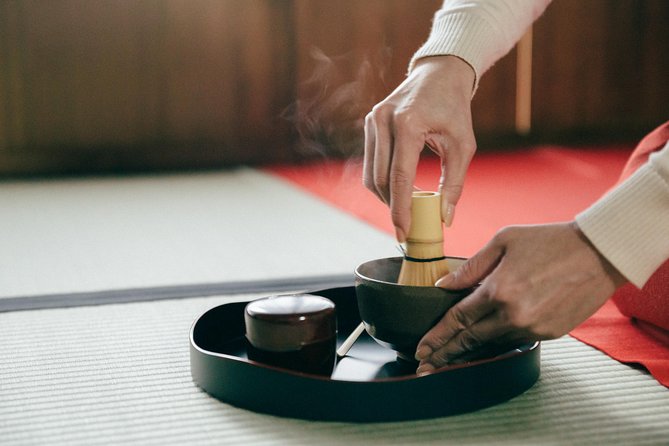
After calligraphy, you move into the tea room. The hosts explain the room’s arrangement and the utensils before serving you a bowl of matcha with Japanese sweets.
That order is helpful. You first watch and receive the tea as a guest, so you can notice the movements and the rhythm without having to perform them immediately. Once you are more comfortable, you try serving tea yourself.
This hands-on part gives you a better sense of tea ceremony than simply drinking matcha. You need to pay attention to the bowl, the utensils, the order of movements, and the feeling of serving another person. The experience frames tea ceremony as a practice of calm attention, not just a tasting stop.
The tea itself may be an acquired taste if you normally drink sweetened tea or coffee. Matcha has a strong, grassy flavor, and the Japanese sweets provide a small counterpoint. Coffee and tea are listed among the inclusions, with one bowl of matcha and some sweets specifically provided.
Tell the host about allergies in advance. Sweets are included, but the available information does not specify their ingredients. This is a small point, yet it matters more here than on a standard sightseeing walk because the refreshments are part of the ceremony.
The tea session is also where the traditional house has its greatest effect. A modern room could teach the same broad steps, but the tatami setting and quiet surroundings make it easier to understand why the ceremony values restraint and focus.
More Tea Ceremony Experiences in Japan:
- Kyoto: Tea Ceremony in a Traditional Tea House in Kiyomizu
★ 4.9 · 3,519 reviews - Kyoto: Tea Ceremony Ju-An at Jotokuji Temple
★ 4.9 · 3,207 reviews - Kyoto: 45-Minute Tea Ceremony Lesson Experience
★ 4.3 · 2,378 reviews - Osaka: Tea Ceremony Experience
★ 4.9 · 1,426 reviews
Meeting Yuzo Mori and his wife
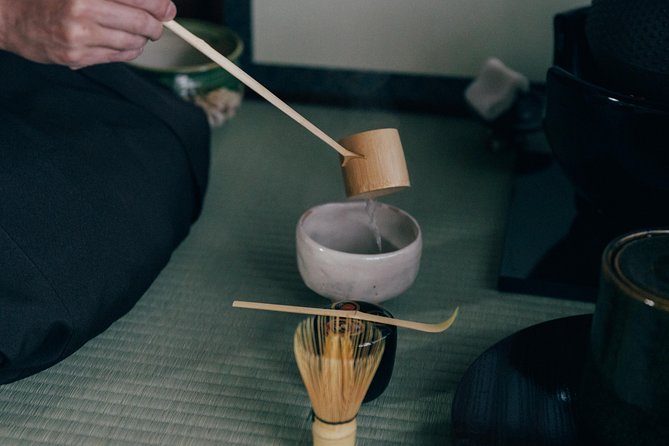
The named host is Yuzo Mori, who leads the experience with his wife. Their role is central because the activity depends on explanation, demonstration, and personal correction rather than on an audio guide or a large scripted show.
English is used throughout. That is especially useful for calligraphy, where a small change in how you hold the brush can affect the result, and for tea ceremony, where the meaning of each movement may not be obvious.
The available information does not give his wife’s name, so you should not expect a formal introduction to a larger staff. This feels like a home-based activity led by a couple, which is part of its appeal and also part of its limit. If you prefer a grand cultural performance with several demonstrations, this may feel modest. If you prefer direct conversation in a private setting, the format should suit you well.
The maximum group size is six. That is small enough for the hosts to watch each person’s calligraphy and let each person try serving tea. It also means the experience can feel more personal than a class with a dozen or more participants.
Is $179.63 a fair price?
At $179.63 per person, this is not a budget activity. You are paying a high rate for 2.5 hours, especially when the inclusions are limited to the cultural lesson, calligraphy materials, one bowl of matcha, and sweets.
The value comes from the combination of elements. You receive an English-language history lesson, access to a traditional house, instruction in two Japanese arts, a framed calligraphy keepsake, and a very small group. The setting is not a backdrop added for decoration. It is part of the lesson.
I would consider the price reasonable for someone who has already seen Nagoya’s major sights and wants a slower, more personal cultural appointment. I would be less likely to recommend it to someone mainly looking for low-cost entertainment, a broad city tour, or a full meal.
The experience also has a strong souvenir value. Instead of buying a mass-produced item, you make a piece connected to your own visit. That does not erase the high price, but it helps explain where the money goes.
The five-out-of-five rating and 100 percent recommendation from 16 ratings suggest strong satisfaction, though the sample is small. I would treat that as encouraging rather than as proof that the activity suits every kind of visitor.
Who will enjoy this experience most?
I would choose this activity if you want a quiet cultural experience with clear instruction and time to practice. It suits couples, solo visitors, families with older children, and anyone curious about Japanese traditions but unsure where to begin.
It is also a good fit if you have already visited castles, museums, and shopping areas in Nagoya. The calligraphy and tea ceremony offer a change of pace, and the Sengoku presentation ties the activities to the city rather than presenting them as isolated customs.
The small group should help people who dislike crowded demonstrations. You can ask questions in English, watch the host closely, and take your turn without feeling lost in a large class.
I would think twice if you dislike sitting quietly, handling unfamiliar tools, or tasting matcha. The experience asks you to slow down. It is not designed as a fast series of photo stops.
Most people can participate, according to the available activity information, but no detailed accessibility information is provided. If you need specific arrangements for mobility, seating, or other access needs, contact the provider before booking.
Timing, booking, and cancellation details
The activity lasts approximately two hours and 30 minutes. It is normally booked about 17 days in advance, so arranging it early is sensible if you have a fixed Nagoya schedule.
Confirmation is normally received at booking. If you book within seven days of travel, confirmation may arrive within 48 hours and remains subject to availability. The ticket is mobile, which means you can show it on your phone at the meeting point.
The cancellation rule is strict. The experience is non-refundable and cannot be changed for any reason, so check your date, meeting point, and plans before paying. The activity begins and ends at the same Nagoya address.
Should you book this calligraphy and tea experience?
Book it if you want personal instruction, a traditional home setting, and two hands-on activities in one appointment. The history briefing, framed calligraphy work, and chance to serve matcha give the session more substance than a simple tea tasting.
Skip it if $179.63 feels too high for a two-and-a-half-hour activity, or if you want a larger performance, a full meal, or a tour of several Nagoya sights. For the right visitor, this is a thoughtful way to connect with Japanese culture. For everyone else, the price may be hard to justify.
FAQ
Where does the experience begin and end?
It begins at 4-chōme-32 Yamawakichō, Showa Ward, Nagoya, Aichi 466-0063, Japan, and ends back at the same meeting point.
How long does the activity last?
The experience lasts approximately two hours and 30 minutes.
How many people can join?
The activity has a maximum of six participants.
Is the experience conducted in English?
Yes. The hosts provide the history explanation and cultural instruction in English.
What is included in the price?
The price includes all Japanese calligraphy tools, one bowl of matcha tea, and some Japanese sweets.
Can I cancel or change my booking?
No. The experience is non-refundable and cannot be changed for any reason.
Just added around Japan
- Yokohama : Tea Ceremony with Sweets and Souvenir★ 5.0 · 5 reviews
- Whisk Your Own Matcha: A Zen Matcha Experience at Temple★ 3.6 · 7 reviews
- Walking Tour: Yanaka,Nezu& Sendagi: Tea Ceremony & Old Tokyo★ 5.0 · 3 reviews
- Visit local home for music and tea ceremony near Disney★ 4.9 · 13 reviews
- Yokohama: Sushi & Gyoza Cooking with Matcha & GreenTea Experience★ 5.0 · 3 reviews
- Trip to Kamakura & Enoshima: Shrines, Seaside, Temples &Tea★ 5.0 · 11 reviews
- Kyoto tea town for matcha lovers★ 5.0 · 16 reviews
- Uji: Private immersion into Kyoto’s tea and reglious culture★ 5.0 · 17 reviews
Tea & Calligraphy Classes, compared.
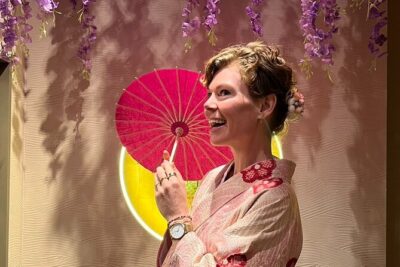
Tea Ceremony, Calligraphy, and Kimono Experience
Read our review →
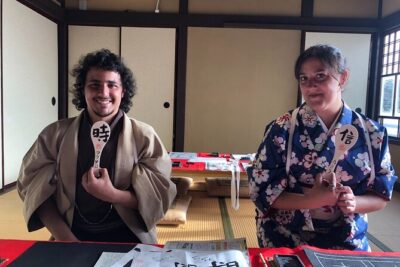
An Amazing set of Cultural experience: Kimono, Tea Ceremony and Calligraphy
Read our review →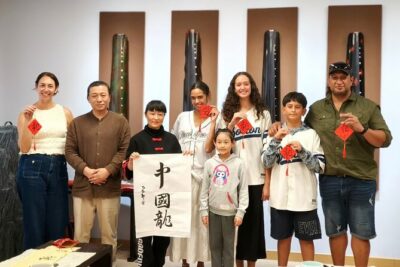
Beijing Culture: Tea Ceremony, Heritage Instrument & Calligraphy
Read our review →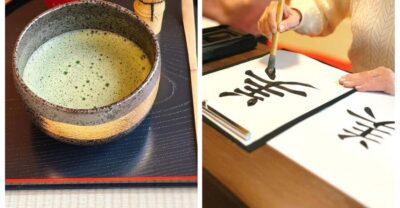
Cultural Activities :Kimono, tea ceremony, Calligraphy and Amulet
Read our review →
Samurai dress-up and shows, plus Tea Ceremony & Calligraphy
Read our review →
Premium Kimono Dressing, Tea Ceremony, Calligraphy, Samurai show
Read our review →Browse the lists this tour appears in