
Review · KYOTO
Kyoto: Uji Matcha Tea Museum Entry Ticket
Uji tea gets more interesting when you can see how it is made, compare Gyokuro and Sencha, and trace the drink back to the town that made it famous. This museum turns those questions into hands-on digital exhibits, so you are not just looking at tea leaves behind glass.
I like two things here. First, the exhibits explain the basics in a way that works for both children and adults. Second, the history room links tea with Uji itself, including the Uji River and the Byodoin Phoenix Hall. The main consideration is simple: this is a museum visit, not a tea-tasting class, and the experience centers on screens and interactive displays.
Key points
- Touchscreen tea lessons: Learn how Uji tea is produced and why different teas taste different.
- Gyokuro and Sencha explained: See the contrast between two well-known Japanese teas.
- Uji history in one room: Follow changes in the town and Uji River through digital exhibits.
- Large Byodoin coin: A huge 10-yen coin featuring Byodoin Phoenix Hall greets you in the history room.
- Family-friendly format: Children and adults can explore the material at their own pace.
- Photo spot at the end: Save time for the tea-themed display in the final corner.
Why Uji tea deserves its own museum
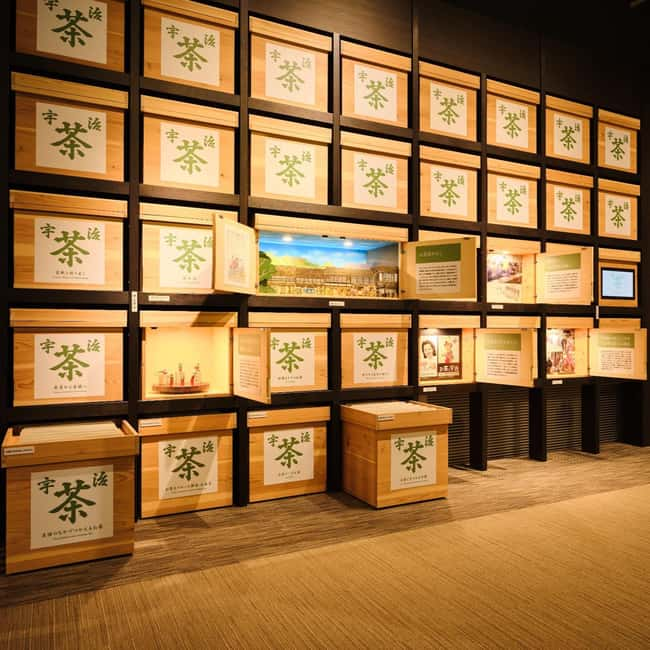
Uji is closely tied to Japanese tea, and this museum gives you a way to understand that connection without needing prior knowledge. Instead of assuming you already know the difference between tea types, it begins with practical questions: How is tea made? Where did Uji tea come from? What makes one tea different from another?
That approach matters because Japanese tea labels can feel confusing. You may see names such as Gyokuro and Sencha and know they are both green teas, but not know how their production affects the final cup. The museum presents those ideas through digital displays that you can touch and explore.
I like this format for a short visit. You can move quickly through familiar material, then spend longer with the topics that catch your attention. If you are visiting with children, the interactive screens offer something to do with your hands instead of asking everyone to read long blocks of text.
More Matcha Experiences in Kyoto:
- Kyoto: Arashiyama Bamboo Forest, Monkeys, Matcha & Temple Tour
★ 5.0 · 759 reviews - Kyoto: Tea Ceremony Meditation – Make Matcha with Tea Master
★ 4.8 · 406 reviews - Kyoto: Kimono Tea Ceremony with Matcha and Sweet
★ 4.9 · 249 reviews
Inside the Uji Tea Room
The Uji Tea Room, called Uji-cha no Ma, is the main stop for understanding how tea reaches your cup. Its exhibits cover the birth story of Uji tea, production methods, and the details behind different varieties.
The displays answer common questions in a direct way. You can learn how tea is made, how Uji tea is produced, and how Gyokuro differs from Sencha. The exhibits also address the best way to prepare a delicious cup, which gives the visit a useful everyday angle.
This is more than a lesson in local branding. Production methods help explain why Japanese teas have different colors, aromas, and flavors. Even if you do not remember every detail, you will leave with a better sense of why tea is treated with such care in Japan.
The digital format is particularly useful here. You can actually touch and experience the exhibits rather than simply reading a panel. That makes the information easier to follow, especially if you are new to Japanese tea or visiting as a family.
Still, keep your expectations in check. The supplied information describes digital exhibitions, not a guided tasting or a workshop where you make tea yourself. If your main goal is to drink several kinds of Uji tea, you may want to pair the museum with a separate tea experience elsewhere in Uji.
Gyokuro and Sencha without the usual confusion
Many visitors recognize the word matcha but know less about other Japanese teas. The museum helps broaden that picture by placing Gyokuro and Sencha in the same conversation.
The value is not just memorizing two names. You can begin to understand that Japanese tea is shaped by how it is grown, handled, and prepared. The museum’s questions about delicious tea also encourage you to think about the final step: preparation at home or in a café.
For a casual visitor, this section may be the most useful part of the visit. You do not need to become a tea expert. You simply gain enough background to make better choices when you see tea on a menu or shop shelf.
I would give this section extra time if you already enjoy Japanese tea. Read the explanations carefully, use the interactive displays, and notice how the museum connects production choices with drinking habits. The information is designed to make you want tea more, which is a fair result for a museum devoted to Uji’s signature drink.
The history room and its giant 10-yen coin
The second major area shifts the focus from tea production to Uji itself. A huge 10-yen coin featuring the Byodoin Phoenix Hall welcomes you into the history room. It is an amusing and memorable object, and it gives the room a strong visual start.
The coin connects the museum to one of Uji’s best-known sights. Byodoin Phoenix Hall appears on the Japanese 10-yen coin, so this display gives you a familiar image at an unusual scale. It also makes a good first photo before you move on to the larger digital presentation.
The history room asks how Uji and the Uji River changed over time. That wider setting is important. Tea did not develop in isolation, and the town’s character is part of what gives Uji tea its identity.
A large 4K HDTV screen shows townscape drawings known as Meisho-zue. This is one of the museum’s main visual attractions. The screen lets you see Uji through detailed illustrated views rather than a simple timeline of dates.
If you have already explored Uji, the screen may help you connect places you saw outside with the town’s earlier appearance. If you are planning to visit Uji after the museum, it can give you useful context before you walk around. Either way, this room adds a sense of place that a tea-only exhibit would miss.
A few more tea experiences around Kyoto worth a look
- Family Mitsui House Museum with green tea admission ticket
★ 4.0 · 5 reviews - Authentic Tea Ceremony & Sushi in The Museum of Kyoto
★ 5.0 · 3 reviews - Kyoto: Tea Museum Tickets and Matcha Grinding Experience
★ 4.9 · 739 reviews - Afternoon Tea at the British Museum
★ 4.2 · 511 reviews
A good stop for children and adults
The museum is built for a wide age range. Children can use the touchable digital displays, while adults can focus on the production methods and local history. That makes the ticket useful for mixed-age groups who may not all want the same kind of museum.
You can also control the pace. The visit is valid for one day, and you can check availability for starting times when you book. That gives you room to fit the museum around other plans in Kyoto or Uji.
The experience may work best as a focused cultural stop rather than an all-day attraction. The supplied details do not give a precise visit length, so you should allow enough time to read the displays and explore the photo area without rushing. The ticket covers museum entry, and the price is listed at $3.87 per person.
At that price, the museum offers good value if you are interested in tea, Japanese food culture, or Uji’s past. The cost is especially reasonable for families, since several age groups can use the same exhibits. The value is lower if you want a full tea ceremony, a personal guide, or a tasting session, none of which is included in the stated ticket.
Finish at the tea-themed photo spot
The final corner includes a tea-themed photo spot. It is an easy detail to overlook if you leave as soon as you finish the history room, so keep a little time for it.
This area gives the visit a lighter ending. After learning about production and local history, you can take photos connected to the museum’s central theme. It is also useful for families, since children may remember the photo moment more clearly than the technical details.
You should not expect the photo spot to replace the museum itself. Think of it as a pleasant final stop, not the main reason to buy the ticket. The strongest parts of the visit are the interactive tea explanations and the large history-room displays.
Practical details before you book
The ticket is for museum entry only. It does not list tea, food, transportation, a guide, or a tea-making activity as included. The experience provider is Chazuna.
You can cancel up to 24 hours in advance for a full refund. You can also reserve now and pay later, which helps if your Kyoto schedule is still changing. The ticket is valid for one day, and you need to check availability for the available starting times.
The museum is wheelchair accessible. No specific language options are provided in the information available, so check the booking details if language support matters to you.
The location is in Honshu, Japan, in the Uji area associated with Kyoto. Since no transport instructions are provided here, plan your route separately and check the exact venue details before setting out.
Who should book the Uji Matcha Tea Museum
I would recommend this museum to you if you want a short, affordable introduction to Uji tea and local history. It suits first-time visitors who want context before exploring Uji, families who need interactive material, and tea drinkers curious about Gyokuro, Sencha, and preparation methods.
You may want to skip it if you are looking specifically for a formal tea ceremony, a guided tasting, or a hands-on lesson in preparing matcha. The museum explains tea well, but the stated experience is entry to digital exhibitions rather than a hosted tea service.
For $3.87, the decision is easy for most tea fans. Book it if you value clear explanations, touchable displays, and a connection between tea and Uji itself. Just reserve your expectations along with your ticket: this is a compact museum visit, not a complete tea ceremony experience.
FAQ
Where is the Uji Matcha Tea Museum located?
The museum is in Uji, in Honshu, Japan, within the Kyoto area.
What does the ticket include?
The ticket includes museum entry.
How long is the ticket valid?
The ticket is valid for one day.
What can I learn in the Uji Tea Room?
You can learn how tea is made, the origins of Uji tea, Uji tea production methods, the difference between Gyokuro and Sencha, and ways to prepare delicious tea.
What is shown in the history room?
The history room explores changes in Uji and the Uji River through digital exhibitions. It also features a huge 10-yen coin with the Byodoin Phoenix Hall and a large 4K HDTV screen showing Meisho-zue townscape drawings.
Is the museum suitable for children?
Yes. The exhibits are designed so children and adults can enjoy learning about tea.
Is the museum wheelchair accessible?
Yes, the activity is wheelchair accessible.
Can I cancel for a full refund?
Yes. You can cancel up to 24 hours in advance for a full refund.
Can I reserve now and pay later?
Yes. The activity allows you to reserve your spot and pay later.
Just added around Kyoto
- Whisk Your Own Matcha: A Zen Matcha Experience at Temple★ 3.6 · 7 reviews
- Uji Walking Tour – Byodo-in temple and Tea Ceremony from Kyoto★ 3.5 · 3 reviews
- Traditional Tea Ceremony in Kyoto★ 4.5 · 3 reviews
- Kyoto: Authentic Tea Ceremony in a Small Group★ 5.0 · 7 reviews
- Tea ceremony at Kyoto’s Zen Temple Teahouse★ 5.0 · 2 reviews
- Tea Ceremony in 150 Years Old Townhouse with Tables and Chairs★ 5.0 · 22 reviews
- Silent Beauty of Kyoto Zen Walk and Tea Experience★ 5.0 · 2 reviews
- Tea Ceremony Experience in Traditional Kyoto Townhouse★ 5.0 · 19 reviews
Matcha Experiences, compared.

World Heritage Kyoto & Nara Uji Authentic Matcha Experience
Read our review →
Matcha Making Class in Tokyo with Authentic Japanese Sweets Set
Read our review →
Tea Museum Tickets and Matcha Grinding Experience
Read our review →
Matcha Making Class in Osaka with Authentic Japanese Sweets Set
Read our review →
Tea Ceremony Meditation – Make Matcha with Tea Master
Read our review →
Matcha Making Experience with Mochi Sweets in Asakusa
Read our review →
Browse the lists this tour appears in