
Review · KYOTO
Kyoto Tea ceremony with Japanese Flower Arrangement Ikebana
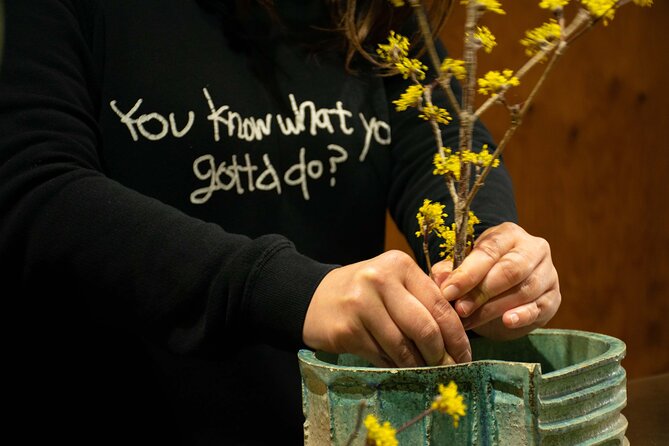
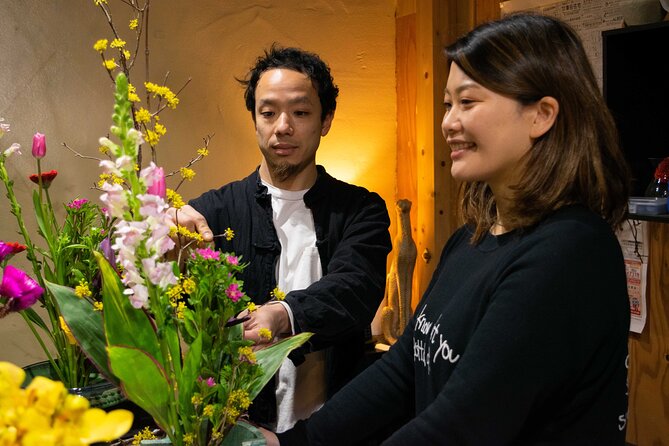
The most memorable part of this Kyoto experience is the move from flower shop to tea room. You choose seasonal flowers, arrange them in your own style, then place your work in the tokonoma, the alcove used to display art in a traditional Japanese room. Your flowers become part of the tea ceremony rather than a souvenir made and quickly forgotten.
I like the small group limit of six and the family-like setting in a renovated townhouse near Kinkaku-ji and Daitoku-ji. I also like that the lesson treats ikebana as quiet reflection, not just a craft class. The main consideration is time: 90 minutes goes quickly, so this is a focused introduction rather than a full study of either art.
Key points
- Choose your own seasonal flowers at the flower shop before the workshop begins.
- Work in a roughly 100-year-old townhouse near two major Kyoto temples.
- Create an ikebana arrangement with guidance, making the class suitable for beginners.
- Display your flowers in the tea room’s tokonoma before the ceremony begins.
- Watch a tea ceremony and try the role of tea master if you wish.
- Take your arrangement with you, subject to the practicalities of carrying it back to your hotel.
A Flower Shop in Northern Kyoto
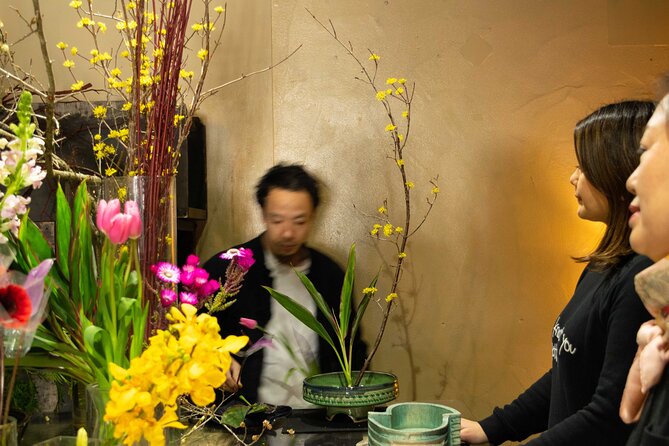
This experience begins at 44-4 Murasakino Kamimonzenchō in Kyoto’s Kita Ward. The setting is a flower shop in a renovated traditional townhouse, about 100 years old. That matters. You are not entering a modern classroom stripped of its surroundings. The building helps set the tone before anyone hands you a flower or explains a technique.
The location is near Kinkaku-ji Temple and Daitoku-ji Temple, two useful landmarks when planning your day. You could pair the activity with temple sightseeing, though the exact timing of your temple visits will depend on your schedule and transport. The meeting point is near public transportation, and the activity returns you to the same place.
The shop is also described as being on a quieter, less tourism-focused street. That gives the experience a local feel, especially compared with a large cultural center where several groups are being processed at once. The setting is simple and personal, which suits an art based on attention to small details.
More Tea Ceremony Experiences in Kyoto:
- Kyoto: Tea Ceremony in a Traditional Tea House in Kiyomizu
★ 4.9 · 3,519 reviews - Kyoto: Tea Ceremony Ju-An at Jotokuji Temple
★ 4.9 · 3,207 reviews - Kyoto: 45-Minute Tea Ceremony Lesson Experience
★ 4.3 · 2,378 reviews
Choosing Flowers for Your Arrangement
Your first task is choosing your favorite flowers from the shop. The selection changes with the seasons, so you will work with what is flowering at that time of year. This is an important part of the lesson. You are not simply handed a fixed kit with identical materials. You begin by looking closely and deciding what attracts you.
The choice also introduces a basic idea behind ikebana: flowers are not treated only as colorful decoration. Their shape, direction, height, texture, and natural form all affect the final arrangement. A curved stem may suggest movement. A spare branch may create space. A flower that seems less perfect may give the arrangement character.
You do not need prior experience. Beginners are welcome, and the instructors guide you through the process. That makes this a good choice if you like Japanese arts but worry that a formal lesson might be intimidating. You can expect help, while still making decisions yourself.
The approach here is slightly different from strict classical forms. The owner gives attention to the natural shape of the plants and tries to bring out their beauty rather than forcing every stem into a rigid pattern. The result can feel simple, raw, and connected to the idea of wabi-sabi, the appreciation of imperfection and change.
Learning Ikebana as a Quiet Practice
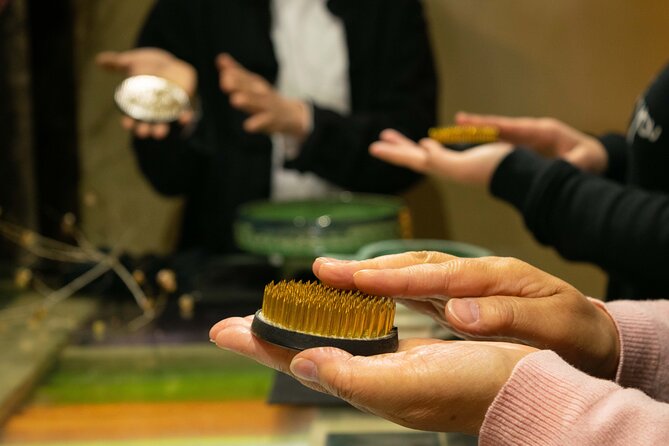
The workshop is not presented as a race to produce a perfect bouquet. It is described as a way to look at nature, show respect for it, and reflect on your own thoughts. That may sound lofty, but the practical value is easy to understand. You slow down, study the material in front of you, and make choices without the usual pressure to move on.
I like this aspect because it gives the flowers a purpose beyond appearance. Your arrangement is an expression of your past and present, at least in the sense that your choices reveal what catches your eye and how you respond to form. You do not need to treat the lesson as formal meditation. Simply working quietly with flowers can provide a welcome pause in a busy Kyoto day.
The instructors are described as patient and informative. That is especially useful in a short class, where unclear directions could eat up much of your time. You will have guidance, but the finished arrangement should still feel like your own work.
Keep your expectations realistic. In 90 minutes, you are unlikely to master the many schools and rules of ikebana. You will get a thoughtful introduction and a chance to make one arrangement. If you want a technical course with extensive practice, this may feel brief. If you want a personal cultural activity that fits into a packed Kyoto itinerary, the length is practical.
Placing Your Work in the Tokonoma
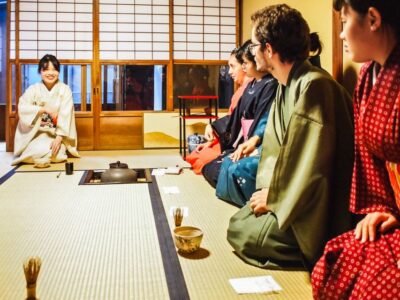
After the ikebana workshop, you move into a traditional Japanese room for the tea ceremony. Your arrangement is displayed in the room’s tokonoma, an alcove traditionally used for a scroll, flowers, or another carefully chosen object.
This transition gives the workshop a satisfying shape. First, you make something. Then you see how it functions within a formal room and ceremony. The arrangement is no longer just an exercise on a table. It becomes part of the room’s visual balance.
The tokonoma also shows why restraint matters in Japanese arts. A single arrangement can carry a great deal of attention when it is placed with care. You may notice the relationship between the flowers, the alcove, and the surrounding room more clearly than you would in the shop.
You are welcome to take your floral creation back to your hotel if you prefer. This is a nice option for people who want a physical reminder of the class. It is also worth thinking about before you book. A flower arrangement may need careful handling, and the activity does not promise a special travel container or long-term preservation. If you have a full day of sightseeing afterward, leaving the arrangement displayed during the experience may be simpler.
A few more tea experiences around Kyoto worth a look
- Kyoto: Table-Style Tea Ceremony at a Kyo-Machiya
★ 4.9 · 1,211 reviews - Kimono Tea Ceremony at Kyoto Maikoya, NISHIKI
★ 5.0 · 911 reviews - Kyoto: Kimono Tea Ceremony at Orizuruya Gion
★ 4.9 · 618 reviews - Kyoto: Tea Ceremony in 100-year-old Kyo-Machiya Townhouse
★ 4.8 · 546 reviews
Watching and Taking Part in the Tea Ceremony
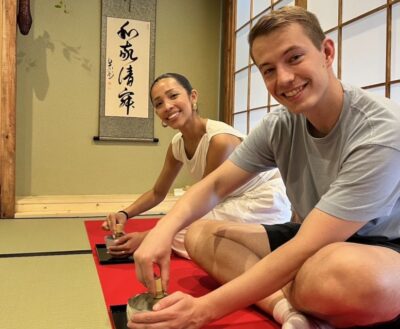
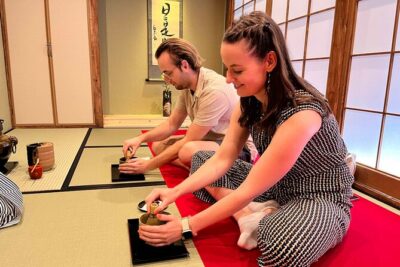
The tea portion follows the ikebana lesson. You can watch the master conduct a tea ceremony and, if you wish, take a role as tea master yourself. That second option makes the activity more than a demonstration. You get a chance to practice the movements and understand the ceremony from inside the process.
Tea ceremony can look highly formal from the outside. Small gestures matter, and the order of actions is part of the experience. A guided introduction helps you see that the ceremony is not simply about drinking tea. It is also about the room, the objects, the flowers, the host, and the attention given to the person receiving the tea.
Your ikebana arrangement remains visible in the tokonoma, linking the two arts. The flowers bring a seasonal element into the room, while the tea ceremony provides a set form for appreciating it. This connection is one of the strongest reasons to choose this activity instead of booking a basic tea tasting on its own.
The tea session is still part of a short combined course. Do not expect a long formal ceremony or a detailed education in every tea school. You will receive an introduction, see how the master performs the ceremony, and may try the role yourself. For many people, that balance will be just right.
Why the Small Group Matters
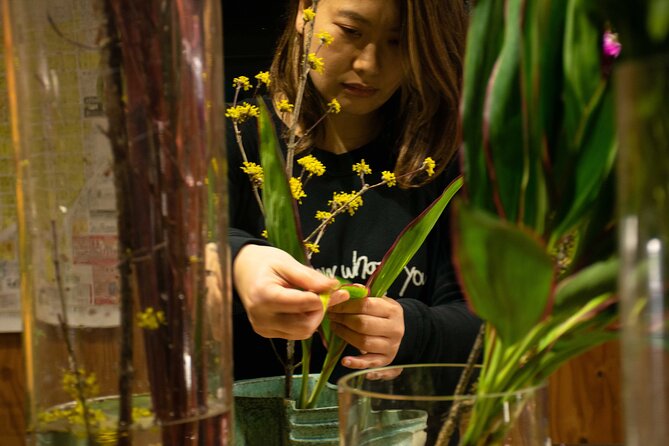
The maximum group size is six. That is a major advantage for a hands-on class. You have a better chance of receiving direct help with flower selection and arrangement, and the room should feel less like a performance for a crowd.
A small group also suits the reflective mood. You can ask questions without raising your voice, and the instructors can notice when you need another explanation. The experience has been described as warm and family-like, which fits the small setting and traditional home atmosphere.
There is one practical limit. A group of six is small, but it is not private. If you want a completely personal lesson with the instructor focused only on you, confirm whether a private booking is available before paying. That option is not specified here.
Solo visitors should find the format comfortable. You do not need to arrive as part of a large party, and the intimate setting gives you a natural way to take part without feeling lost in a crowd. Couples and small families may also appreciate the shared activity, especially if everyone wants to make something rather than only watch.
The Value of $61 for 90 Minutes
At $61, this experience is priced above a simple cultural demonstration but below the cost of many longer guided activities. The value comes from the combination of two arts, the flower materials, the small group, the traditional setting, and the chance to create something yourself.
You are paying for more than tea. You are also paying for instruction, seasonal flowers, use of the workshop space, access to the traditional room, and the chance to display your arrangement during the ceremony. If you value direct participation, the price is reasonable.
The value is less clear if you only want to sample Japanese tea or take a quick photo in a traditional room. In that case, part of the cost goes toward an ikebana lesson you may not care about. I would book this for the combined experience, not for either half alone.
The 90-minute duration works well for a Kyoto schedule. It leaves room for a temple visit, a meal, or other sightseeing nearby. At the same time, it means you should arrive ready to focus. Late arrival would take a noticeable portion of the class, and the activity is designed as one connected sequence.
Who Will Enjoy This Most
I would recommend this experience to you if you want a calm cultural activity with real participation. It suits first-time ikebana students, people interested in Japanese design, and anyone who would rather make something than sit through a lecture.
It is also a strong fit for solo visitors. The intimate setting and patient instruction can make a solo booking feel personal rather than awkward. Couples may enjoy comparing their flower choices and seeing how differently each arrangement develops.
Families can take part if everyone can manage a quiet, focused class. The activity is not described with a minimum age, so you should confirm suitability for young children before booking. The traditional room and flowers call for careful handling.
You may want to skip it if your Kyoto schedule is already packed with timed attractions and you dislike slower activities. The point is not speed. The point is attention, choice, and a short break from sightseeing.
Practical Details Before You Book
Your mobile ticket is convenient, and confirmation is sent within 48 hours, subject to availability. Because the class is limited to six people, I would avoid leaving the booking until the last moment if your Kyoto dates are fixed.
The meeting point is 44-4 Murasakino Kamimonzenchō, Kita Ward, Kyoto, postal code 603-8217. The activity ends back at this same point. Check the route carefully before setting out, especially if you are coming from another part of the city.
Most people can participate, and service animals are allowed. The experience is near public transportation, but no detailed accessibility information is provided. If you need specific assistance with the townhouse, seating, stairs, or the traditional room, ask before booking rather than assuming.
Cancellation is free up to 24 hours before the start time for a full refund. A cancellation made within 24 hours is not refunded, and changes within that period are not accepted. Cutoff times follow local Kyoto time, so keep that in mind if you are booking from another time zone.
Should You Book This Kyoto Tea and Flower Experience?
Book it if you want a small, gentle introduction to two traditional arts, with enough hands-on work to make the hour and a half feel personal. The flower choice, natural-form approach, tokonoma display, and chance to try the tea master’s role give the activity more depth than a basic tea stop.
I would especially choose it for a quieter day near Kinkaku-ji or Daitoku-ji, or for a solo trip when you want a welcoming setting. I would pass if you want a long, highly technical ikebana course or a full formal tea ceremony. At $61, it offers good value for a compact, participatory experience, as long as you want both ikebana and tea rather than only one.
FAQ
Where does the Kyoto tea ceremony and ikebana experience begin?
It begins at 44-4 Murasakino Kamimonzenchō, Kita Ward, Kyoto, 603-8217, Japan.
Where does the activity end?
The activity ends back at the meeting point.
How long does the experience last?
The experience lasts approximately 1 hour and 30 minutes.
How many people can join?
The activity has a maximum group size of six people.
Is the class suitable for beginners?
Yes. Beginners are welcome to join the ikebana workshop.
Do I choose the flowers myself?
Yes. You begin by selecting your favorite seasonal flowers from the flower shop.
Can I take my ikebana arrangement to my hotel?
Yes. You are welcome to take your floral creation to your hotel if you wish.
Will I see a tea ceremony?
Yes. After the ikebana workshop, you can watch the master conduct a tea ceremony.
Can I take part as the tea master?
Yes. You can take a role as tea master if you wish.
Are service animals allowed?
Yes. Service animals are allowed.
What is the cancellation policy?
You can cancel at least 24 hours before the start time for a full refund. Cancellations made less than 24 hours before the start time are not refunded.
Just added around Kyoto
- Whisk Your Own Matcha: A Zen Matcha Experience at Temple★ 3.6 · 7 reviews
- Uji Walking Tour – Byodo-in temple and Tea Ceremony from Kyoto★ 3.5 · 3 reviews
- Kyoto: Authentic Tea Ceremony in a Small Group★ 5.0 · 7 reviews
- Tea ceremony at Kyoto’s Zen Temple Teahouse★ 5.0 · 2 reviews
- Traditional Tea Ceremony in Kyoto★ 4.5 · 3 reviews
- Tea Ceremony in 150 Years Old Townhouse with Tables and Chairs★ 5.0 · 22 reviews
- Silent Beauty of Kyoto Zen Walk and Tea Experience★ 5.0 · 2 reviews
- Tea Ceremony Experience in Traditional Kyoto Townhouse★ 5.0 · 19 reviews
Tea Ceremony Experiences, compared.
Tea Ceremony in a Traditional Tea House in Kiyomizu
Read our review →
Browse the lists this tour appears in