
Review · KYOTO
Kyoto: Tea Ceremony with Maiko
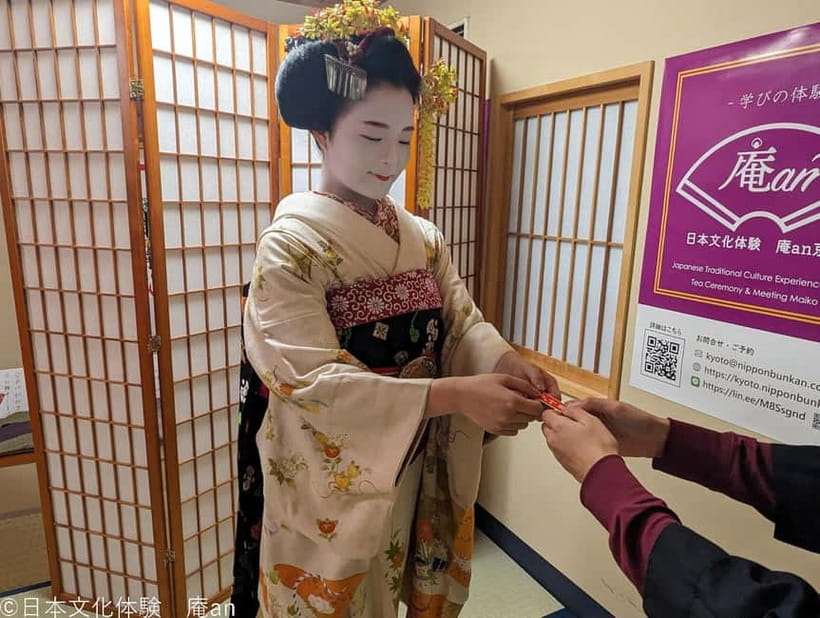
Meeting a maiko over a bowl of matcha gives this short Kyoto activity its appeal. You watch her demonstrate the tea ritual, make your own tea, ask direct questions about her life, and finish with a photo and a small Senjafuda lucky charm.
I like the easy location, just a minute from Gojo Station, and the low $28 price. I also like that this is more than a staged photo stop: the question-and-answer period lets you learn about the demanding path from maiko to geiko. The main consideration is the setting. This is a room in a building, not a traditional teahouse, and English support can vary.
Key points at a glance
- A real maiko or geiko leads the session: The host may be a maiko or geiko, depending on the date.
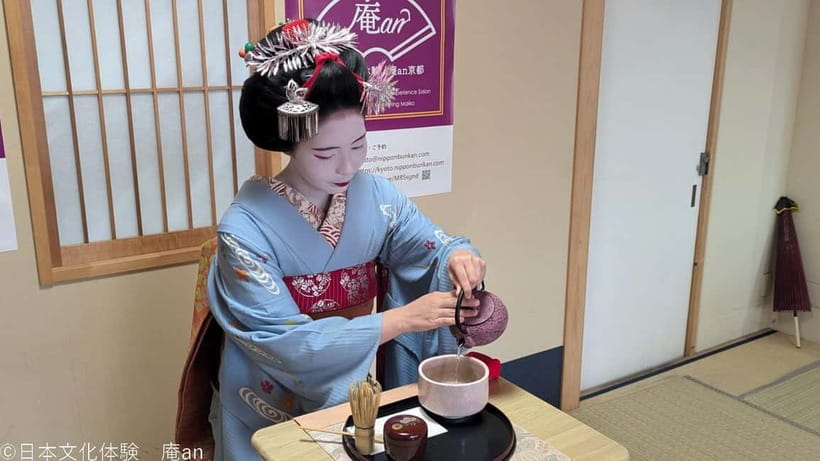
- You make your own matcha: The demonstration is followed by hands-on preparation, with two dried Japanese sweets called ohigashi.
- Questions are welcome: The conversation gives you a closer look at daily life and the road toward becoming a geiko.
- Photos are built in: You can take a commemorative photo beside the performer at the end.
- The location saves time: Gojo Station is a one-minute walk away, and Kyoto Station is close by.
- Plan for stairs and punctuality: There is no elevator, and late arrivals cannot be accommodated.
A maiko experience that fits into a busy Kyoto day
Kyoto offers plenty of long cultural programs, but you may not have half a day to spare. This one takes about 45 minutes, with the main program ending around the 30-minute mark and room departure by approximately 45 minutes.
That timing makes it useful before a train, between sightseeing stops, or during a short stay in Kyoto. You still get the main parts of the experience: a greeting, tea demonstration, matcha preparation, sweets, questions, photographs, and the Senjafuda gift.
The session is priced at $28 per person, which is a reasonable rate for a hosted cultural activity with a performer, matcha, sweets, translation support when available, and a photo opportunity. It is not a full traditional tea ceremony in a historic house, so the value comes from the personal contact and compact format rather than the architecture.
The overall rating is 3.5 out of 5 from 174 ratings, so you should set realistic expectations. Many people leave pleased with the maiko’s grace, the chance to ask questions, and the smooth organization. A smaller number may find the modern venue or limited language support less atmospheric than expected.
More Tea Ceremony Experiences in Kyoto:
- Kyoto: Tea Ceremony in a Traditional Tea House in Kiyomizu
★ 4.9 · 3,519 reviews - Kyoto: Tea Ceremony Ju-An at Jotokuji Temple
★ 4.9 · 3,207 reviews - Kyoto: 45-Minute Tea Ceremony Lesson Experience
★ 4.3 · 2,378 reviews
Finding the room near Gojo Station
The meeting point is at Exit 1 of Gojo Station on the Subway Karasuma Line. From there, the walk takes about one minute. The entrance faces Gojo-dori, the main street.
The location is one of the best practical features. You do not need to cross Kyoto or spend a long morning finding a distant teahouse. If you are coming from Kyoto Station, the area is close enough to make this an easy addition to a central itinerary.
Still, allow a few extra minutes to identify the entrance. The room is above a supermarket called Carnival, and you reach it by stairs. A useful route is to leave through Exit 1, walk straight, cross a small street, continue ahead, and look for the venue before the next small street. You should not arrive at the last second, especially if you do not know the area.
There is no elevator in the building. If stairs are difficult for you, check the physical demands before booking. The activity itself is short, but the venue access is not step-free.
What happens during the 45 minutes
The program begins with a greeting from the maiko or geiko. The host staff then helps explain how the session will run. The performer may speak mainly in Japanese, but English translation is provided as much as possible if you request it in advance.
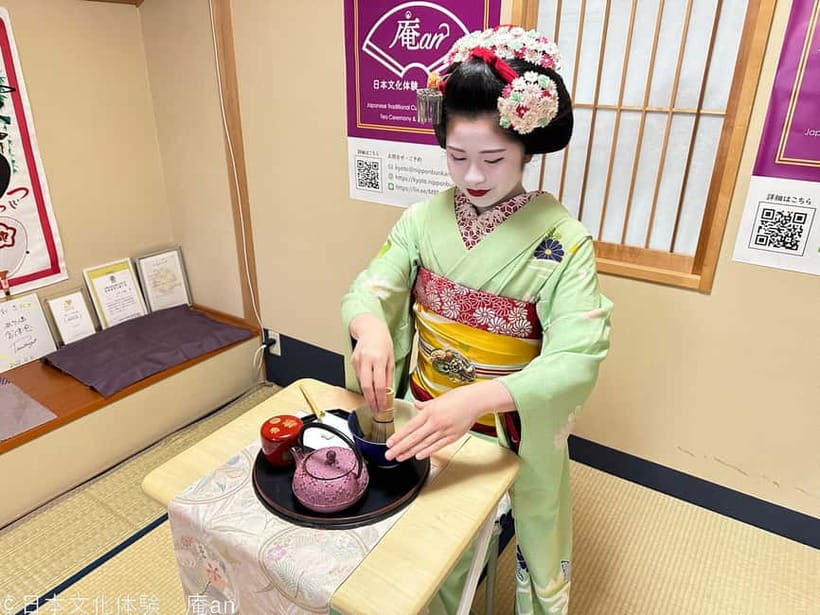
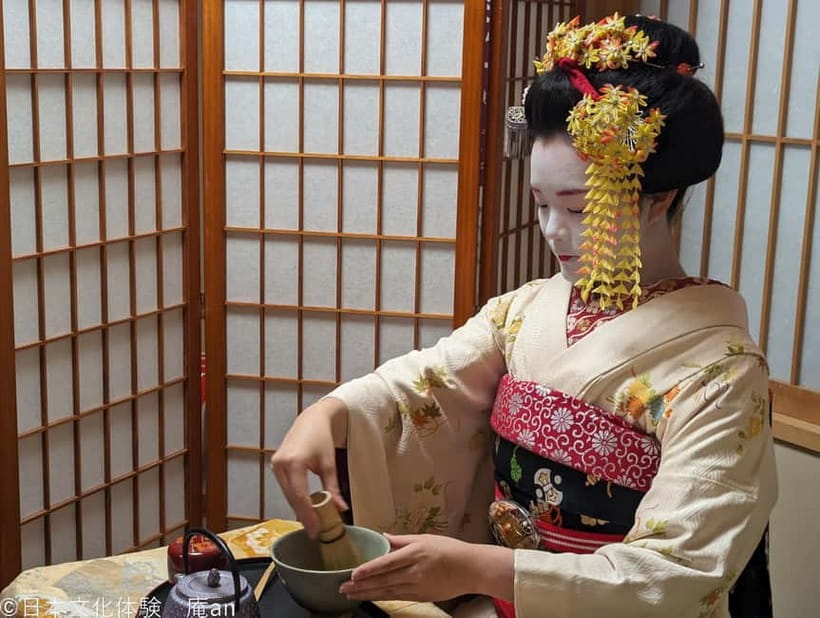
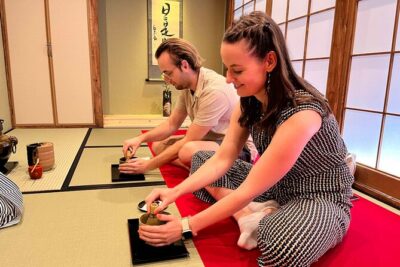
The first main activity is the tea demonstration. The maiko shows how to prepare matcha and explains the process before you try it yourself. You are not simply watching a formal ritual from a distance. You receive the chance to whisk your own tea, which makes the ceremony easier to understand.
Your matcha comes with two dried Japanese sweets called ohigashi. These are small, traditional sweets designed to be eaten with tea. They add a pleasant contrast to the slightly bitter matcha and give you a simple taste of the etiquette surrounding Japanese tea.
The activity does not require special preparation. You do not need to bring tea equipment or know the correct movements ahead of time. The staff and performer guide you through the process, so first-time participants can take part without feeling tested.
After the tea, the session moves into a question-and-answer period. This is where the program becomes more personal. You can ask about a maiko’s daily life, training, work, and progression toward becoming a geiko. The value here depends on your questions, so prepare a few before you arrive.
The program information places the end of the main portion at about 30 minutes. The final 15 minutes allow for a photo beside the performer, the Senjafuda presentation, and departure from the room. Exact pacing may vary, especially if the session includes additional interaction.
Learning about the road from maiko to geiko
A maiko is not simply a performer in costume for a quick photograph. The role involves a distinctive way of life, and the question period gives you a chance to ask about it directly.
One especially useful point is the transition from maiko to geiko. A maiko is an apprentice, while a geiko is an established entertainer. The session can help you understand that these are related but different stages, rather than two interchangeable words for the same role.
The questions do not need to be formal. You might ask about the daily routine, training, clothing, performance work, or what changes when a maiko becomes a geiko. The experience is strongest when you treat the conversation as a chance to learn, not just as a backdrop for photographs.
Language is the practical limit. The listed activity language is Japanese. English translation is offered as much as possible, and some sessions have had a helpful interpreter who explained the maiko’s answers. Still, you should request English assistance ahead of time rather than assume every exchange will be fully translated.
The name Masaya-san appears in one especially positive account of the matcha instruction. You should not expect her at every session, since the host may be a different maiko or a geiko depending on the date.
A few more tea experiences around Kyoto worth a look
- Kyoto: Table-Style Tea Ceremony at a Kyo-Machiya
★ 4.9 · 1,211 reviews - Kimono Tea Ceremony at Kyoto Maikoya, NISHIKI
★ 5.0 · 911 reviews - Kyoto: Kimono Tea Ceremony at Orizuruya Gion
★ 4.9 · 618 reviews - Kyoto: Tea Ceremony in 100-year-old Kyo-Machiya Townhouse
★ 4.8 · 546 reviews
Making matcha instead of only watching
The hands-on tea preparation is likely to be the most satisfying part for many people. The maiko first demonstrates the method, then you make your own bowl. That simple change from spectator to participant matters.
You can pay closer attention to the movement of the whisk, the consistency of the tea, and the order of the steps. Even if your bowl is not perfect, the process gives you a better feel for the care behind matcha preparation.
The format is friendly rather than intimidating. You are not expected to have studied tea ceremony etiquette before arriving. The staff explains what to do, and the maiko’s demonstration gives you a model to follow.
This is also a good activity for families with older children who can sit and take part. Children under two who sit on a parent’s lap are free. Any child who needs their own seat pays the same $28 fee as one adult participant.
The included food is limited to two ohigashi sweets and matcha. Do not book this expecting a meal. The program may sometimes be held alongside people having lunch or dinner, so the room can have a shared dining atmosphere rather than the quiet of a private tea room.
The photo and Senjafuda finale
The photo opportunity comes after the tea and questions. You can take a commemorative photograph standing beside the maiko or geiko. This is a useful arrangement because the photograph follows an actual introduction and activity, rather than being the entire purpose of the visit.
The Senjafuda is a small paper charm traditionally associated with a person’s name or dedication. Here, it is given to you as a lucky keepsake. It is a modest gift, but it gives the experience a clear final moment and is easy to carry home.
You should follow the staff’s directions for photographs and avoid treating the performer like a public attraction. The activity creates a respectful, organized way to meet her up close, which is much better than trying to spot or approach a maiko on the street.
The performer then leaves the room, and you depart soon after. Since the program is tightly timed, there is not much room for late questions or an extended photo session.
A modern room, not a traditional ochaya
The biggest atmosphere question is the venue. This is not an ochaya, and it is not held in a traditional Japanese house. It takes place in a building near Gojo Station, with a relaxed room and friendly staff.
That arrangement keeps the price down and makes the activity easy to reach. It also means you should not book it for old wood, tatami rooms, garden views, or the sense of entering a historic teahouse. The cultural content comes from the maiko, the tea, and the conversation.
I see this as a fair trade for a short introduction. If your priority is meeting a maiko and learning directly from her, the ordinary building may not matter much. If the room itself is central to your idea of a Kyoto tea ceremony, you may want a more traditional setting.
Some sessions may take place with people having lunch or dinner. That can make the experience feel less private and less ceremonious, but it may also create a more relaxed mood. The program information does not promise a private group, so keep that possibility in mind.
Timing, cancellations, and language support
Arrive early. The event cannot be held for latecomers, and a late arrival does not qualify for a refund. This is especially important because the experience lasts only 45 minutes and follows a fixed order.
Reservations are processed during operating hours from 10:00 AM to 5:00 PM. Requests received after 5:00 PM are handled the next day. You can cancel up to eight days in advance for a full refund, but changes within seven days may incur a fee, and other cancellation fees can apply.
The provider does not compensate you for transport costs if the activity is canceled. That is a practical reason not to schedule an expensive, nonrefundable connection immediately afterward.
Request English translation when you book. The host aims to provide it as much as possible, but the official activity language is Japanese. If asking questions is a major reason you are booking, language support should be part of your decision rather than an afterthought.
Who will get the most from this activity
I would choose this for a first visit to Kyoto, a short stop near Kyoto Station, or a day when you want one cultural activity without committing several hours.
It suits you especially well if you:
- Want to meet a maiko in a respectful, organized setting
- Like learning through questions rather than only watching
- Have never prepared matcha and want a simple introduction
- Need a central location and a short schedule
- Want a modest keepsake and a photograph
- Are comfortable with a modern venue and stairs
It may not suit you if you want a full-length tea ceremony in a traditional house, a private session, or guaranteed fluent English throughout. It is also a poor fit if you need step-free access or cannot arrive well before the scheduled start.
The activity can work for couples, solo visitors, families with suitable children, and small groups. The relaxed tone and hands-on tea preparation make it less formal than some traditional ceremonies, while the maiko gives it a distinctive Kyoto focus.
Should you book the Kyoto maiko tea ceremony?
Book it if you want an affordable, compact meeting with a maiko or geiko and you value direct conversation over elaborate surroundings. At $28, the combination of demonstration, matcha, sweets, questions, photo, and Senjafuda is good value for a 45-minute cultural stop.
Go in expecting a modern room, stairs, Japanese-led instruction, and translation that may depend on the session. Arrive early, request English help ahead of time, and prepare a few thoughtful questions.
I would recommend it most strongly to someone with limited time who wants more than a photograph. The tea preparation gives you something to do, the questions give the meeting substance, and the charm gives you a small reminder of the encounter. If you want the full atmosphere of a traditional Kyoto teahouse, choose a longer and more formal option instead.
FAQ
Where is the tea ceremony held?
The venue is a one-minute walk from Exit 1 of Gojo Station on the Subway Karasuma Line. The entrance faces Gojo-dori and is above the Carnival supermarket.
How long does the experience take?
The full activity lasts about 45 minutes. The main program ends at around 30 minutes, followed by photographs, the Senjafuda gift, and room departure.
Will a maiko lead every session?
The experience may be hosted by either a maiko or a geiko, depending on the event date.
Is English provided?
The official activity language is Japanese. English translation is provided as much as possible if you request it, so contact the provider in advance if you need language assistance.
What is included in the price?
The price includes the tea ceremony with a maiko or geiko, matcha, two dried Japanese sweets, the photo opportunity, and a Senjafuda gift.
Is the venue accessible by elevator?
No. The building has no elevator, and you need to use stairs to reach the venue.
Just added around Kyoto
- Whisk Your Own Matcha: A Zen Matcha Experience at Temple★ 3.6 · 7 reviews
- Uji Walking Tour – Byodo-in temple and Tea Ceremony from Kyoto★ 3.5 · 3 reviews
- Traditional Tea Ceremony in Kyoto★ 4.5 · 3 reviews
- Kyoto: Authentic Tea Ceremony in a Small Group★ 5.0 · 7 reviews
- Tea ceremony at Kyoto’s Zen Temple Teahouse★ 5.0 · 2 reviews
- Tea Ceremony in 150 Years Old Townhouse with Tables and Chairs★ 5.0 · 22 reviews
- Silent Beauty of Kyoto Zen Walk and Tea Experience★ 5.0 · 2 reviews
- Tea Ceremony Experience in Traditional Kyoto Townhouse★ 5.0 · 19 reviews
Tea Ceremony Experiences, compared.
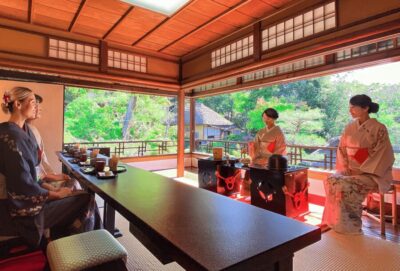
Tea Ceremony in a Traditional Tea House in Kiyomizu
Read our review →
Browse the lists this tour appears in